The short answer: many US small businesses can run a focused Google Ads test with $1,000 to $2,500 per month in ad spend, while competitive industries or larger service areas may need $3,000 to $5,000 or more. A very narrow campaign can start below $1,000, but a smaller budget also buys fewer clicks and produces slower learning.
Those figures are planning ranges, not Google requirements or performance guarantees. Google does not publish one fixed price for advertising. Your real cost depends on what people search, where you advertise, how many businesses compete for those searches, and how well your ads and landing pages match the user's intent.
The better question is not simply, “What does Google Ads cost?” It is:
How much do I need to spend to generate enough qualified opportunities to judge whether Google Ads can be profitable for my business?
That is the question this guide will help you answer.
Here is a practical starting framework for a US small business.
| Monthly ad spend | Approx. daily budget | What that budget may support |
|---|---|---|
| $500 to $1,000 | $16 to $33/day | A tightly focused test in one small market or a lower-cost niche; data may accumulate slowly |
| $1,000 to $2,500 | $33 to $82/day | A practical starting range for many focused Search campaigns |
| $2,500 to $5,000 | $82 to $164/day | More coverage, more expensive clicks, multiple high-intent themes, or a more competitive market |
| $5,000+ | $164+/day | Competitive industries, larger territories, multiple services, or faster testing and expansion |
These are not packages sold by Google. They are planning ranges. A dentist in a large city, a local attorney, an online clothing store, and a B2B software company can all face completely different costs.
According to LocaliQ's 2026 search advertising benchmark report, the average cost per click across the industries it studied was $5.42. The same report showed major differences by category: $1.63 for arts and entertainment, $8.00 for dentists and dental services, $8.33 for home and home improvement, and $9.87 for attorneys and legal services. Treat these as directional benchmarks, not quotes for your account.
The most useful estimate will always come from your own market, keywords, website, economics, and conversion data.
Google Ads does not have one universal minimum monthly spend that every advertiser must meet. You control the average daily budget for each campaign.
But “Google lets me start with a small amount” and “that amount is enough to run a useful test” are two different statements.
Suppose your average click costs $8 and your daily budget is $10. That campaign may receive roughly one click on some days and no clicks on others. Even if the campaign is well built, it can take a long time to collect enough visits, leads, and sales to make a confident decision.
That does not mean every business needs a huge budget. It means the budget must make sense relative to the auction you are entering.
I would rather run one narrow campaign with a realistic budget than spread the same money across five services, ten cities, and several campaign types. When the budget is limited, focus is what makes the test useful.
Campaign selection also changes how that budget is used. Review our practical guide to choosing between Search and Performance Max before dividing spend across multiple campaign types.
The total cost of Google Ads can include more than the amount charged by Google.
This is the money paid directly to Google for clicks, views, impressions, or conversions, depending on the campaign and bidding setup.
For Search campaigns, cost per click is usually the number small-business owners notice first. If you spend $2,000 and receive 400 clicks, your average CPC is $5.
You may manage the account yourself, employ someone internally, hire a freelancer, or use an agency. Management may be charged as a flat fee, an hourly rate, a percentage of ad spend, or a combination.
Management cost should be evaluated separately from ad spend. The ad budget buys traffic. Management covers the work required to structure campaigns, control search terms, test ads, allocate budgets, verify tracking, and improve performance.
Adzlance uses a flat monthly management fee based on account complexity rather than charging a percentage of spend. You can review what is included in our Google Ads management service.
A campaign may also need landing-page improvements, Google Tag Manager work, call tracking, e-commerce measurement, CRM integration, or offline conversion tracking.
These are not optional details when the account is expected to optimize for leads or sales. If a form submission fires twice, a purchase value is missing, or every phone click is treated as a qualified lead, the campaign is learning from the wrong signals.
Depending on the business, there may be costs for call tracking, feed-management tools, product photography, video, design, reporting, or landing-page software.
A simple local Search campaign may need very little beyond the website and accurate conversion tracking. An e-commerce or multi-channel account may require more supporting infrastructure.
Google Ads works through an auction. Every time an eligible search occurs, advertisers can compete for available ad placements.
Your bid matters, but it is not the only factor.
Google explains that actual CPC can be influenced by auction-time ad quality, expected click-through rate, ad relevance, landing-page experience, Ad Rank thresholds, competition, the context of the search, and the expected impact of ad assets.
This is why the advertiser with the highest bid does not automatically receive the best result in every auction.
A relevant ad and useful landing page can improve your ability to compete. A high bid cannot permanently rescue an account where the keyword, ad, offer, and landing page have little connection.
Google also notes that your actual CPC is often lower than your maximum CPC bid because you generally pay what is required to clear the relevant thresholds and compete in the auction. Automated bidding can behave differently because Google adjusts bids auction by auction toward the selected goal.
The practical lesson is simple: you control the budget, but the market and campaign quality influence what that budget can buy.
Some searches are worth more to advertisers because one new customer can generate substantial revenue. Legal, dental, home improvement, financial, and certain B2B searches can therefore attract aggressive competition.
An expensive click is not automatically a bad click. A $20 click that helps generate a profitable customer may be more valuable than a $2 click from someone with no buying intent.
Costs can vary between states, cities, ZIP codes, and local markets. A service keyword in a dense metropolitan area may face more competition than the same keyword in a smaller town.
Geographic reach also affects the budget you need. Covering one service area is very different from targeting an entire state or the whole country.
Keywords that show immediate commercial intent usually cost more than broad research terms.
“Emergency plumber near me” can be more valuable than “how does a water heater work” because the first search suggests an urgent need and a possible purchase.
The cheaper informational click is not necessarily the better use of a lead-generation budget.
Broad targeting can reach more searches, including queries you did not expect. That may help discovery, but it can also spend money on weak or irrelevant traffic when tracking and negative-keyword control are poor.
The keyword list is only the starting point. The search terms report shows the actual queries consuming the budget.
If the ad closely matches the search and the landing page answers the user's need, the campaign has a stronger foundation.
If the ad promises one service and the landing page opens on a generic homepage, the visitor has to work out whether they are in the right place. That friction can reduce conversion rate and make every lead more expensive.
Manual CPC, Maximize Clicks, Maximize Conversions, Target CPA, and Target ROAS do not all pursue the same outcome.
For example, Google states that Maximize Conversions is designed to use the available budget to generate as many conversions as possible. Selecting that strategy does not mean Google will spend only when a conversion is guaranteed. It means the system will bid toward the conversion signals it receives.
Auction pressure and demand can change throughout the year. Tax services, travel, retail, education, home services, and event-related businesses may see meaningful seasonal shifts.
One month's CPC or conversion rate should not be treated as a permanent price list.
For many small businesses, $1,000 to $2,500 per month is a reasonable starting point for a focused Search campaign. This range is large enough to create a useful test in many markets without pretending it will suit every advertiser.
A budget below $1,000 may still work when:
A budget of $3,000 to $5,000 or more may be more realistic when:
Do not choose the monthly budget only because another small business spends that amount. Start with the economics of your own customer.
Here is the framework I would use.
Choose a target that the business can actually serve. More leads are not useful if calls are missed, appointments are unavailable, or inventory cannot support demand.
If 25% of qualified leads become customers, you need approximately four qualified leads for each customer.
Required qualified leads = target customers ÷ close rate
If you want eight customers and close 25% of qualified leads: 8 ÷ 0.25 = 32 qualified leads
Consider revenue, gross profit, repeat purchases, sales costs, refunds, and the margin the business needs to keep.
If a new customer is worth $300 in allowable acquisition cost and 25% of qualified leads become customers: $300 × 0.25 = $75 per qualified lead
If the business wants 32 qualified leads and can afford $75 per qualified lead: 32 × $75 = $2,400 in estimated monthly ad spend
This is a hypothetical planning example, not a forecast. The first campaign may perform above or below the estimate. But the calculation gives the budget a business reason.
Use Google Keyword Planner to review estimated clicks, average CPC, cost, and impression forecasts for your keywords and locations. Google explains that these forecasts account for inputs such as bid, budget, seasonality, historical ad quality, and match types.
Forecasts are estimates, not promises. Still, they are more useful than copying a generic budget from an unrelated industry.
Google Ads uses an average daily budget for most campaigns. To estimate a monthly limit, multiply the average daily budget by 30.4:
| Average daily budget | Approximate monthly spending limit |
|---|---|
| $20 | $608 |
| $33 | $1,003.20 |
| $50 | $1,520 |
| $82 | $2,492.80 |
| $100 | $3,040 |
Google says that most campaigns can spend up to twice the average daily budget on an individual day when traffic is stronger, while the monthly spending limit is generally 30.4 times the average daily budget.
That means a campaign set to $50 per day may spend more than $50 on a busy day and less on another day. The budget is an average, not always a strict daily cap.
Business owners should understand this before assuming the account has overspent simply because one day's cost is higher than the number entered in campaign settings.
Small businesses often try to reduce CPC before checking whether the clicks create real customers. Consider two campaigns:
| Metric | Campaign A | Campaign B |
|---|---|---|
| Spend | $2,000 | $2,000 |
| Average CPC | $4 | $8 |
| Clicks | 500 | 250 |
| Qualified leads | 10 | 20 |
| Customers | 2 | 6 |
| Customer acquisition cost | $1,000 | $333.33 |
Campaign A buys twice as many clicks at half the CPC. Campaign B acquires three times as many customers.
If the business focuses only on CPC, it may pause the campaign that is producing the better commercial result.
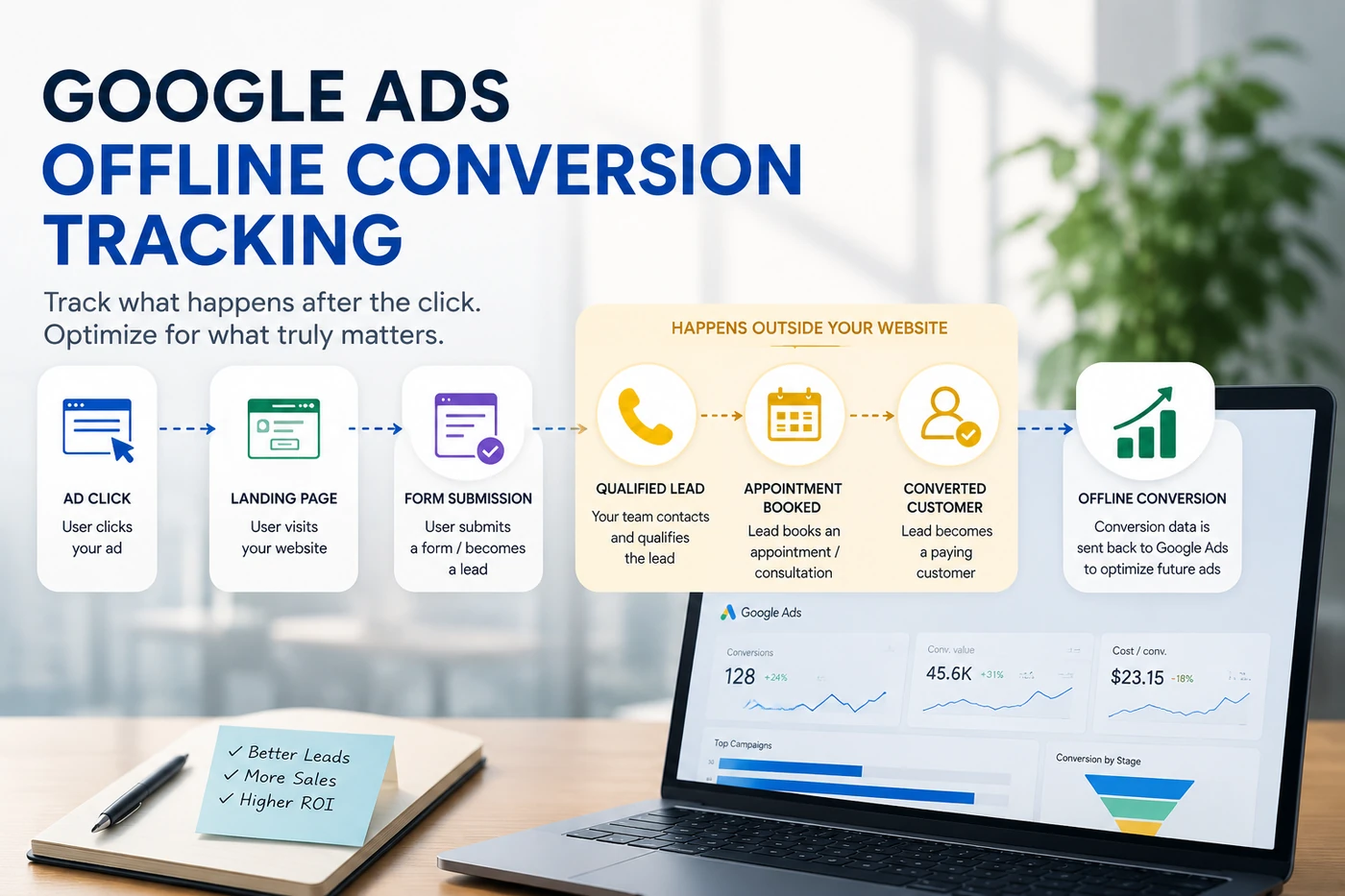
This is why I look beyond clicks and form fills. For lead generation, I want to know which leads were qualified, booked, quoted, and closed. Our guide to Google Ads offline conversion tracking explains how that information can be connected back to the account.
Seeing why clicks may not become customers? That guide works through the diagnosis in order.
Sending paid traffic to a slow, confusing, or generic page can make every acquisition more expensive.
Before increasing the budget, check whether the page clearly explains the service, builds trust, works on mobile, and makes the next step obvious.
Google Ads can generate an inquiry, but it cannot make the business answer the phone or follow up quickly.
If half the leads are never contacted, the reported campaign CPL may look acceptable while the real customer acquisition cost is poor.
Duplicate purchases, repeated thank-you-page events, unqualified phone clicks, and imported analytics events can distort performance.
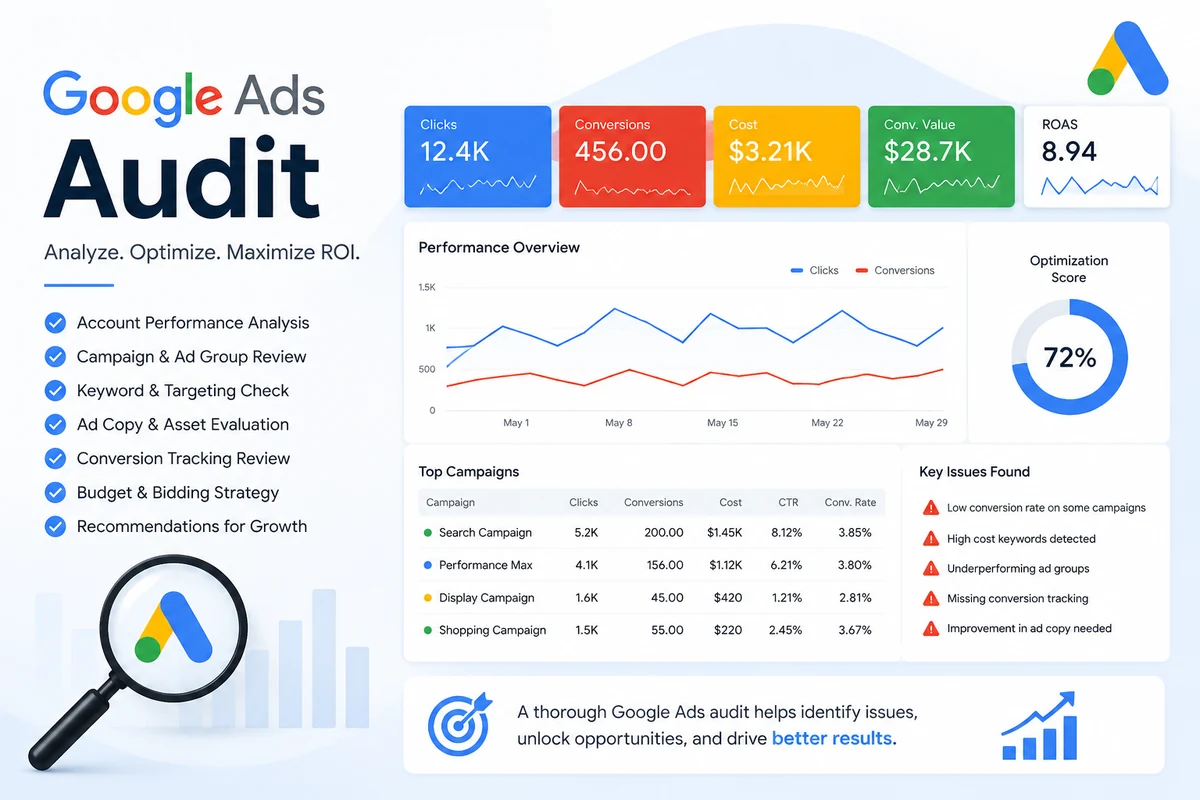
Before scaling, review the tracking and the rest of the account against a proper Google Ads audit checklist.
A $1,500 monthly budget divided across five campaigns gives each campaign roughly $10 per day. That may be insufficient in a market where one click costs $8 or more.
Consolidating around the highest-value service can produce a more useful test.
Choose the service or product where search demand, profit, and your ability to convert the customer are strongest.
Do not target an entire state if the business serves only a 20-mile radius. Location waste is still waste, even when the keyword is relevant.
Add negative keywords when searches are irrelevant, informational, outside the offer, or otherwise unlikely to become good customers.
The page should continue the same promise made in the keyword and ad. A specific service ad normally deserves a specific service page.
Track purchases, booked appointments, qualified leads, and closed customers where possible. Do not train the bidding system around shallow actions just because they are easy to count.
Someone searching for your company name is different from someone discovering the business through a generic service search. Reporting them together can make acquisition performance look stronger than it really is.
If the campaign is spending on irrelevant searches or broken tracking, adding budget gives the problem more money. Fix the foundation first.
For a broader setup and optimization framework, read Google Ads for Small Businesses: The Complete Guide.
There is no honest answer that fits every business.
A campaign with a $5 CPC and a $3,000 monthly budget can collect information much faster than a campaign with a $20 CPC and a $600 monthly budget. A business with a one-day buying cycle can evaluate customers sooner than a company with a three-month sales process.
I would define the test by useful volume rather than an arbitrary number of days.
The campaign should have enough activity to answer questions such as:
Thirty days is often a reasonable first review window, but it is not always enough to declare a channel profitable or unprofitable. The required time depends on traffic, conversion volume, seasonality, and the sales cycle.
I would not rush into Google Ads when:
Google Ads can capture existing demand. It does not automatically create a strong business proposition.
Google Ads can be worth the cost when the campaign reaches people with real intent, the website converts them, the business follows up, and the value of the resulting customers exceeds the full acquisition cost.
It is not worth the cost simply because the dashboard reports clicks or conversions.
Start with a focused test. Know what a customer is worth. Measure what happens after the lead. Then increase the budget only when the numbers justify it.
We can help you estimate a practical budget, check your tracking, and identify where spend may be wasted, starting with a free audit of your account.
Request a free Google Ads audit →You can also review what is included in our Google Ads management service.
Six questions business owners ask most often about Google Ads costs. Use the arrows or dots to move between them.
Many US small businesses can start with $1,000 to $2,500 per month in ad spend for a focused Search campaign. A narrow campaign may start below $1,000, while competitive industries, larger markets, or multiple services may require $3,000 to $5,000 or more. The right amount depends on local CPCs, conversion rates, customer value, and the volume needed for a meaningful test.
Gurdeep Singh is the founder of Adzlance, a paid media agency specializing in Google Ads, Meta Ads, conversion tracking and performance-focused advertising.
Benchmark figures and Google budget rules last verified August 2026. Third-party benchmarks are directional only, check current documentation before planning a budget.
For service-specific spending scenarios and lead-cost calculations, read our guide to HVAC advertising budget.
Running a dental practice? Our guide to dental advertising costs covers treatment budgets and affordable patient acquisition.
Practical writing on paid media, based on real account work.
Compare fees, scope, and advertising spend in our guide to Google Ads management cost in the USA.