I’ve been managing Google Ads accounts for more than five years, and there’s one problem I see repeatedly in lead-generation campaigns.
The account looks good inside Google Ads.
It might show 50 conversions. The cost per lead looks reasonable. Maximize Conversions is bringing in leads, and according to the dashboard, everything seems to be working.
Then you speak to the sales team.
Out of those 50 leads, maybe 15 were actually qualified. Eight booked an appointment. Four eventually became customers.
Google doesn’t automatically know that.
If all you’re tracking is the original form submission, the bidding system may see all 50 leads as successful conversions, even though the business knows there was a huge difference in their quality.
This is where Google Ads offline conversion tracking becomes extremely useful. Instead of ending your measurement when someone submits a form, you can send information about what happened after that lead back to Google Ads.
That changes the question from “Which ads generate leads?” to “Which ads generate leads that actually become customers?” Those are two very different questions.
Let’s use a simple example. Someone searches Google for “dentist near me.” They click your ad, visit your landing page and submit an appointment form. Google records the form submission as a conversion.
But the most important part of the customer journey happens afterward. The receptionist calls the lead. The person books an appointment. They show up. Eventually, they become a patient worth $1,500 to the practice.
If you’re only tracking the online form submission, Google may know about the lead but not necessarily the final business outcome.
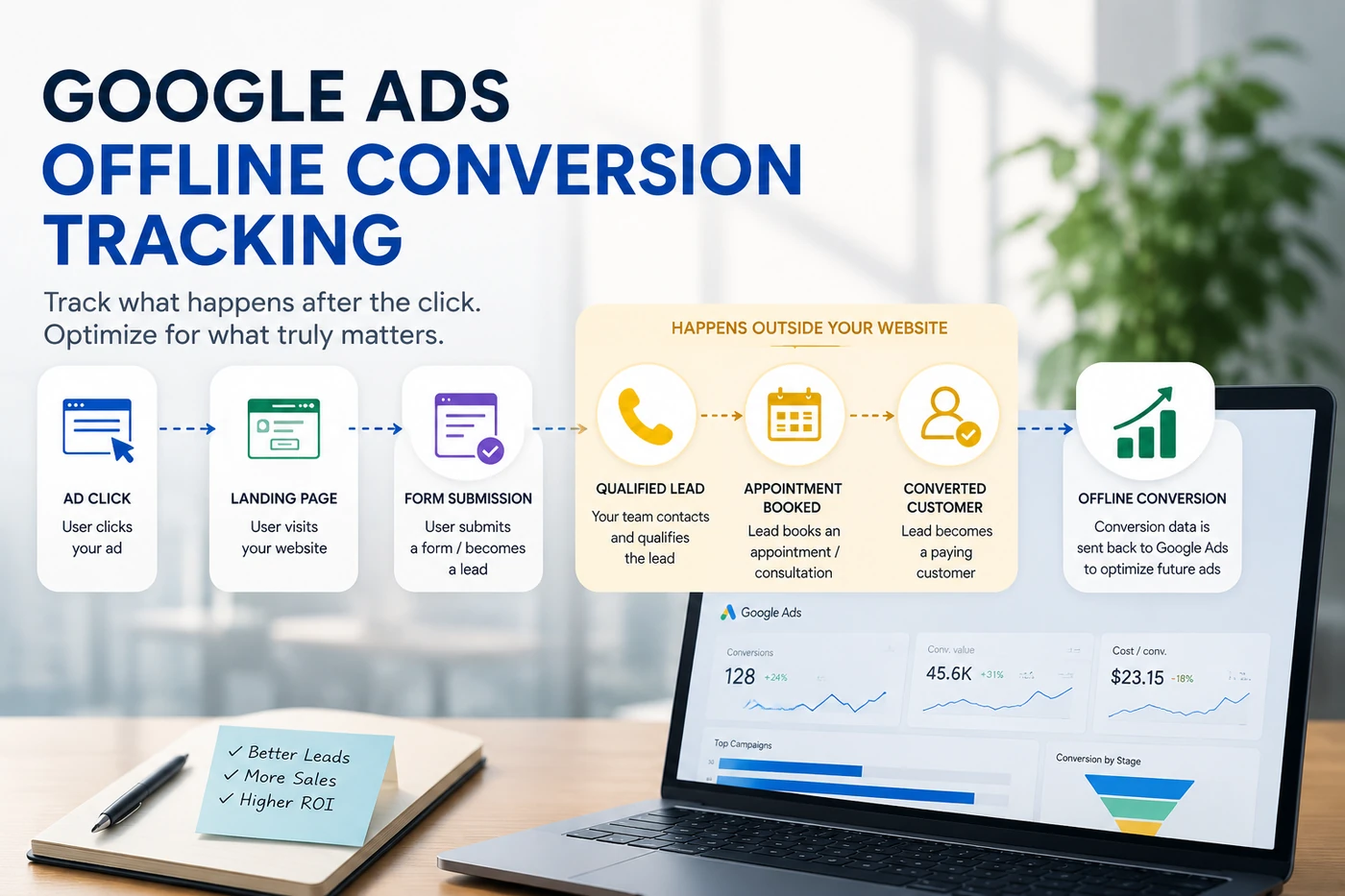
Without offline tracking: Ad Click → Form Submission
With offline tracking: Ad Click → Form Submission → Qualified Lead → Appointment Booked → Customer
That’s the part I care about. Getting 100 leads sounds great until you discover that 90 of them were never going to become customers.
Imagine Google generates 20 leads from Keyword A and 10 leads from Keyword B. Looking only at the initial conversion numbers, Keyword A appears to be the clear winner.
But then you check your CRM:
Which keyword would you rather spend more money on? Keyword B.
But Google can only optimize based on the information available to it. If all you’re feeding back is the original form submission, Google sees Keyword A = 20 conversions and Keyword B = 10 conversions.
Google isn’t necessarily doing anything wrong. It’s optimizing toward the information you’ve given it.
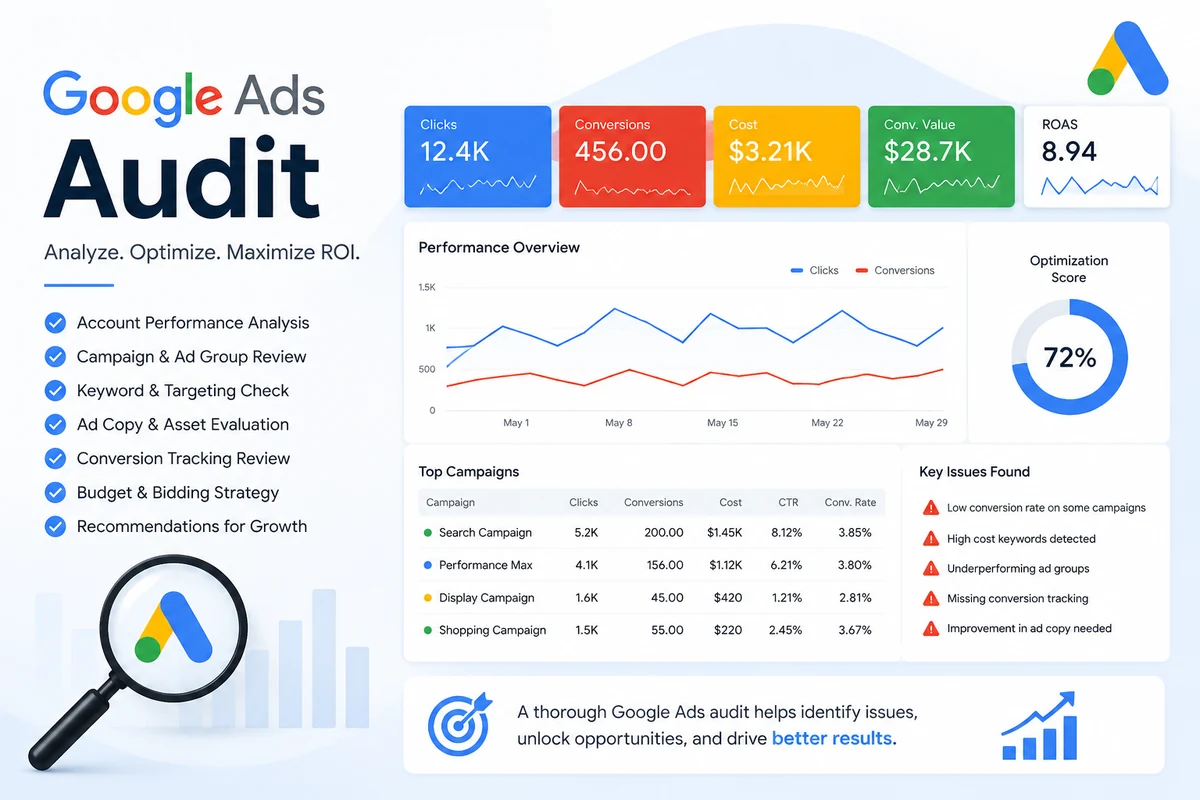
That’s one of the reasons I pay so much attention to conversion tracking when auditing an account. An account can technically have conversion tracking installed correctly while still measuring the wrong business outcome. I’ve written separately about the recurring issues I find during a Google Ads account audit.
Seeing clicks but no reported conversions? That guide works through the diagnosis in order.
This becomes much more important once you start giving Google’s bidding system more control.
If you’re using Maximize Conversions, Target CPA or another conversion-focused strategy, you’re asking Google to use the conversion signals available to it when making bidding decisions.
But automation doesn’t automatically know what a good lead means to your business.
If every form submission is treated as a successful conversion, you’re essentially asking Google to find more people who submit forms. You’re not necessarily asking it to find more people who become customers.
With offline conversion data, you can start measuring deeper stages such as Lead, Qualified Lead, Appointment Booked and Converted Lead. Now you’re moving beyond lead generation and toward actual business outcomes.
This is also why I consider accurate conversion tracking an important part of Google Ads management services. Bidding, keywords and ads matter, but the quality of the information you’re feeding back into the account matters just as much.
Let’s take two campaigns. Both generate 30 leads.
If you’re looking only at CPL, Campaign A wins. But Campaign A spent $3,000 to acquire two customers, a $1,500 customer acquisition cost. Campaign B spent $3,600 to acquire seven customers, approximately $514.
Now which campaign looks better? Campaign B.
This is why I don’t like judging lead-generation campaigns using CPL alone. Cheap leads and profitable leads are not the same thing.
This is where things become more technical. A visitor interacts with your Google ad and eventually submits a lead. The information required for attribution then needs to continue through your lead-management process:
Google Ad → Website → Form Submission → CRM → Qualified Lead → Customer
When the customer reaches an important offline stage, that information can be sent back to Google Ads through a supported implementation.
Historically, Google Click ID, or GCLID, has played an important role in connecting offline actions back to ad clicks.
Today, advertisers should also understand Enhanced Conversions for Leads. It can use first-party customer information collected through your website, such as an email address or phone number, together with imported offline conversion information to improve measurement. The implementation still needs to comply with Google’s customer-data policies and applicable privacy requirements.
The main point is that offline tracking isn’t simply another website tag. Your website, lead forms, CRM and Google Ads measurement need to work together.
If you’re researching this topic, you’ll probably come across both terms.
Traditional offline conversion import allows businesses to send offline outcomes back to Google Ads. Google now recommends Enhanced Conversions for Leads for advertisers starting this type of measurement.
Enhanced Conversions for Leads builds on offline measurement by using privacy-safe, hashed first-party customer information alongside imported lead outcomes to improve matching and measurement.
So if I were implementing offline measurement for a new lead-generation account today, I wouldn’t automatically build everything around an older GCLID-only workflow. I’d first look at the business’s current website, CRM and data setup and decide which supported implementation makes the most sense.
This is where advertisers can easily overcomplicate things. You don’t need to send every possible sales action back to Google.
I would start by asking: which events actually tell me that this lead is becoming more valuable?
The exact funnel is different for every business. What matters is that the offline conversions represent genuine progress toward revenue.
I would rather work with a smaller amount of clean, meaningful conversion data than feed Google a large amount of noise.
A phone-number click isn’t necessarily a qualified phone call. A form submission isn’t necessarily a qualified lead. A qualified lead isn’t necessarily a booked appointment. And a booked appointment isn’t necessarily a customer.
These actions shouldn’t automatically be treated as though they mean the same thing.
Before deciding what Google should optimize toward, I want to understand:
This is where good Google Ads campaign management and good measurement start working together.
E-commerce businesses often have a relatively straightforward online journey. Someone clicks an ad, purchases a product and completes the transaction online.
Lead generation can be very different. The most valuable part of the journey often happens away from the website.
If you only measure the original lead, you’re missing the part of the journey that matters most to the business.
This is why offline conversion tracking can be particularly valuable for businesses investing in Google Ads management services for lead generation. The objective isn’t simply to generate more leads. It’s to generate more of the right leads.
You don’t need to be spending $100,000 per month on Google Ads before thinking about offline conversions. What you need is a reliable lead-management process.
Ask yourself: can I tell what happened to a lead after it came in?
If your sales team receives a form submission and nobody records whether the lead was qualified, booked or closed, there isn’t much useful offline information to send back.
But if you’re already using a CRM and consistently updating lead stages, you’re sitting on valuable information. That’s when I would seriously consider connecting that data back to Google Ads.
We’ll review your current tracking, understand how your business handles leads, identify which offline actions are worth measuring and set up the appropriate tracking process.
Contact Adzlance to Set Up Offline Conversion Tracking →Offline conversion tracking isn’t a magic fix.
If your keywords are poor, location targeting is wrong, search terms aren’t being reviewed, your landing page doesn’t convert or your sales team isn’t following up properly, importing better conversion data isn’t suddenly going to make the campaign profitable.
It gives Google and the advertiser better information. You still need to manage the campaign properly. I think of it as improving the feedback loop.
Without offline tracking: Google Ads → Lead
With offline tracking: Google Ads → Lead → Sales Process → Customer → Data Back to Google Ads
That second loop tells us considerably more about what’s actually producing revenue.
CPL is useful. I look at it all the time. But CPL isn’t the end goal.
If Campaign A produces $40 leads that never answer the phone and Campaign B produces $80 leads that consistently become customers, I don’t want to blindly optimize toward the $40 CPL. I want to understand which advertising is producing actual business.
That’s what makes Google Ads offline conversion tracking so useful. It connects advertising performance with what happens after the click.
And as Google Ads becomes increasingly automated, I think that connection becomes even more important. The bidding system can only work with the signals available to it. The better those signals represent actual business outcomes, the more useful that automation can become.
Google Ads offline conversion tracking allows you to measure important customer actions that happen after an online ad interaction, such as a lead becoming qualified, booking an appointment or becoming a customer.
Yes. Lead generation is one of the clearest use cases because the final sale often happens through a phone call, sales team, CRM or in-person interaction rather than directly on the website.
Enhanced Conversions for Leads is Google’s upgraded approach to offline lead measurement. It can use hashed first-party customer data, such as email addresses or phone numbers, together with imported offline conversion information to improve measurement.
A CRM makes the process considerably easier because it provides a structured way to record what happens to leads. However, the appropriate implementation depends on how your business stores and manages lead information.
Offline conversion data can be used as part of your conversion measurement and bidding setup when implemented appropriately. The important part is choosing meaningful conversion actions and ensuring the imported data is accurate.
If you’re running lead-generation campaigns and measuring performance only by form submissions or phone calls, you’re probably seeing only part of the customer journey.
Start looking beyond the lead. Which leads were qualified? Which booked? Which became customers? Which generated revenue?
Once you can answer those questions consistently, Google Ads offline conversion tracking can help connect those business outcomes back to your advertising.
For me, that’s the real value of the setup. Not simply getting more conversions to appear in the dashboard. It’s understanding which advertising is actually creating customers.
If you’re looking for professional Google Ads management services, Adzlance helps businesses manage campaigns, improve conversion tracking and make advertising decisions based on meaningful business outcomes rather than surface-level metrics.
Gurdeep Singh is the founder of Adzlance, a paid media agency specializing in Google Ads, Meta Ads, conversion tracking and performance-focused advertising.
For an appointment-based example, read our guide to tracking healthcare appointments and patient outcomes.
See how tracking dental appointments helps connect advertising spend with attended visits.
Practical writing on paid media, based on real account work.