If you run Google or Meta campaigns, your instinct will be to map ChatGPT Ads onto what you already know. That instinct is the problem. The controls you rely on, match types, negative keywords, lookalike audiences, retargeting pools , do not exist here. Not hidden in a submenu. They do not exist.
This is a practical comparison of the three platforms as they stand in August 2026, written for people who buy media rather than people writing about it.
Everything else follows from that difference.
Here is the whole picture in one place. The rest of this article explains what each row actually means when you are inside the platform.
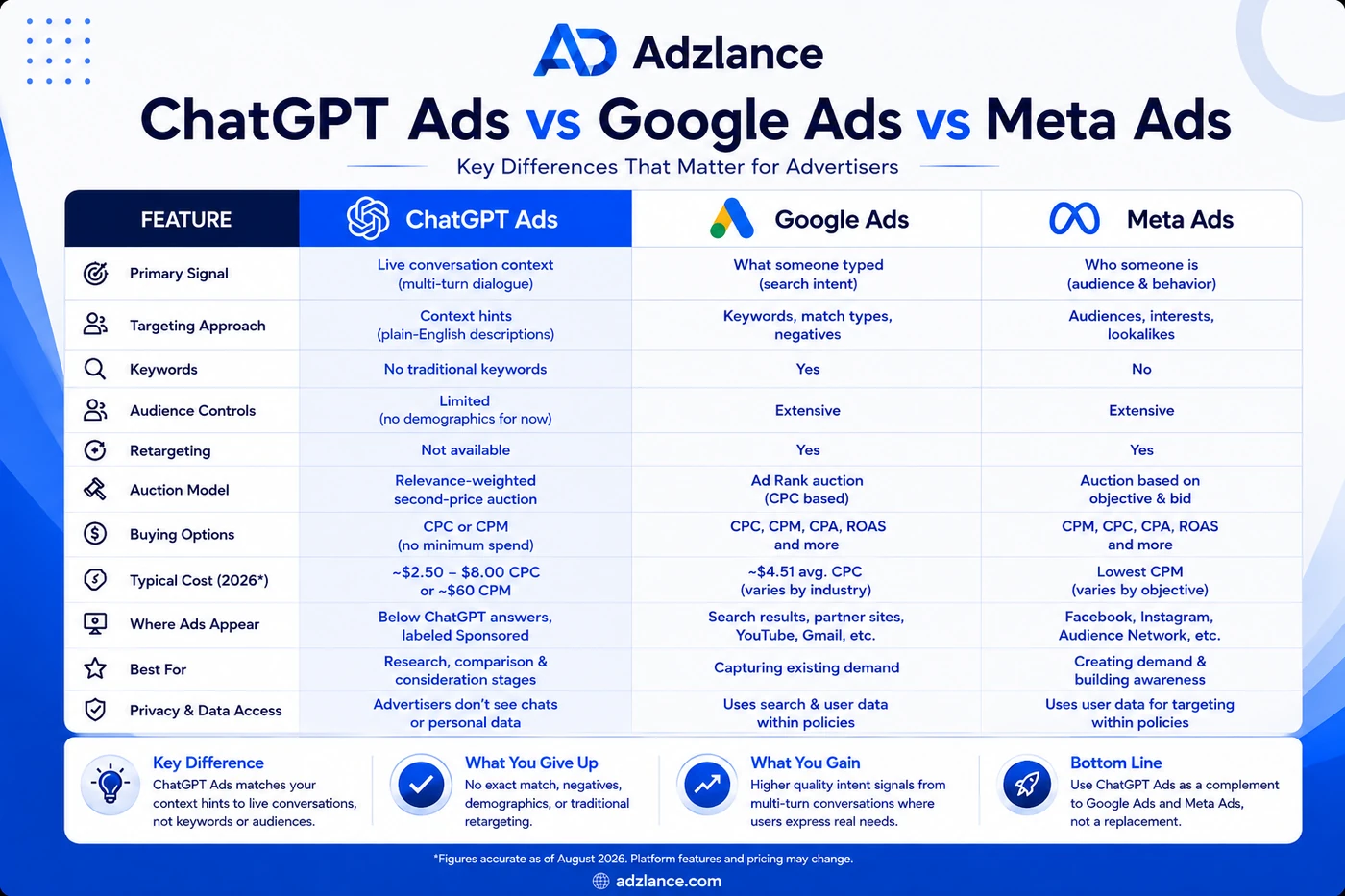
On Google you build keyword lists, apply match types, and mine search terms to add negatives. On Meta you build custom audiences, lookalikes and interest stacks.
On ChatGPT you write context hints, plain-English descriptions, set at ad group level, of the situations where your product is the right answer. Not keywords. Not search terms. Descriptions. Our guide to ChatGPT Ads targeting options explains how those hints interact with location, platform, custom audiences and relevance signals.
A keyword targets "project management software". A context hint targets "someone comparing project management tools for a 20-person team that has outgrown spreadsheets". The second is a brief to a media planner, not a match-type formula.
OpenAI's system then matches those hints against live conversational intent using a relevance-weighted second-price auction. Bidding more does not force irrelevant placements , relevance is weighted into the auction itself.
This is the part most advertisers underestimate. These are structural design decisions, not features awaiting release.
If your account depends on precise segmentation and a well-maintained negative list, that entire skill set does not transfer.
One thing, and it is significant: the quality of the intent signal.
A Google search query is two to four words. A ChatGPT conversation is a multi-turn dialogue in which someone progressively describes their actual situation, budget, team size, what they have already tried, what went wrong. That is far more context than a query ever captures.
The user is also mid-problem rather than mid-scroll. They are researching, comparing, asking for a recommendation. Ads appear below the answer, clearly labelled Sponsored, at roughly one placement per five conversations.
Ads never influence the answer. OpenAI's "answer independence" principle keeps ad serving on infrastructure physically separate from the model generating responses. ChatGPT writes its reply first; a separate system then decides whether a relevant ad fits. You cannot pay your way into a recommendation.
Two implications worth sitting with. First, the audience skews toward non-paying users, which shapes who you reach. Second, CPCs are soft because few advertisers in any given vertical have optimisation data yet, and that window closes as more of them arrive.
For a full breakdown, see current ChatGPT Ads costs.
For the full picture on how the platform works, see our complete ChatGPT Ads guide.
Yes, if Google and Meta are already running profitably with accurate conversion tracking, and you sell something people research conversationally.
Not yet, if your existing channels are not properly measured. Adding an immature platform to a stack you cannot measure produces noise, not insight.
Probably not, if you need predictable volume this quarter. Reporting is thinner, inventory is limited, and the product changes month to month, custom audiences, conversion-optimised campaigns and finer location targeting have all been rolling out through 2026.
Treat it as an addition, never a replacement. The honest framing is that this is early-stage buying with a genuine first-mover advantage, not a mature growth channel.
Ready to build one? The step-by-step setup guide walks through the Ads Manager from account creation to billing, including the character limits that aren't what the interface says they are.
We manage campaigns across ChatGPT, Google, Meta, Amazon and Microsoft, and we will tell you honestly whether it fits your business before you spend anything.
See how we run ChatGPT Ads →Figures accurate as of August 2026. This platform changes monthly, check OpenAI's documentation for current pricing and targeting options before planning a budget.
Practical writing on paid media, based on real account work.