ChatGPT Ads are no longer just an idea advertisers are watching from the sidelines. OpenAI now has an Ads Manager where eligible businesses can create campaigns, organize ad groups, upload creative, measure conversions, and optimize performance.
That does not mean you should copy your Google Ads structure, change a few labels, and expect the same result.
ChatGPT is a different advertising environment. A person may spend several messages explaining what they need, comparing options, narrowing a shortlist, or asking what to do next. The opportunity for an advertiser is not simply to match a keyword. It is to become relevant to the decision the person is already trying to make.
That sounds powerful, and it can be. But this is still a developing platform. Controls, reporting, benchmarks, and best practices are not as mature as they are on Google or Meta. I would treat ChatGPT Ads as a structured test alongside proven channels, not as an automatic replacement for them.
This guide explains how ChatGPT Ads work, what the platform currently offers, how I would structure a first campaign, what to measure, and how to decide whether the channel deserves more budget.
If your main question is whether the channel deserves a test at all, read our practical assessment of whether ChatGPT Ads are worth testing for a small business.
ChatGPT Ads are paid placements shown below ChatGPT responses. OpenAI says each ad can include the advertiser name, favicon, title, description, landing page, and an image. Ads are clearly labeled and remain separate from the answer itself.
That separation matters. An advertiser is not paying to rewrite ChatGPT's answer or force a recommendation into it. The ad is a distinct sponsored placement that can appear when the system expects it to be relevant to the user's situation.
OpenAI says delivery can consider several signals, including:
OpenAI also states that ads are not shown to users on Plus, Pro, or Business plans, or to accounts identified as belonging to people under 18. Advertisers should therefore avoid assuming that every ChatGPT user is part of the available ad audience.
On Google Search, an advertiser usually starts with a query.
Someone types “best accounting software for a small business,” and the campaign tries to match that search with a relevant keyword, ad, and landing page.
Inside ChatGPT, the same person may explain that they run a 12-person service company, need invoicing and payroll, use a particular CRM, and want software that their accountant can access. That is a much richer expression of the problem.
ChatGPT Ads are designed around that conversational context. The system is not limited to one short search phrase. It can consider what the person appears to be trying to accomplish in the current conversation.
This changes the advertiser's job. Instead of asking only, “Which keywords should I buy?” you also need to ask:
The platform still needs clear inputs. Richer context does not rescue a vague offer, generic creative, or weak landing page.
OpenAI describes the ad auction as relevance-weighted and second-price. In practical terms, your maximum bid matters, but delivery is not based on the bid alone. The system also aims to account for expected relevance and outcomes.
That makes the following elements part of your targeting and delivery system:
The important lesson is familiar: you cannot permanently fix poor relevance by bidding more.
If an ad group mixes unrelated products, the context hints are vague, the copy promises one thing, and the landing page talks about something else, the campaign gives the system weak signals. A higher bid may buy more opportunities, but it does not create a coherent customer journey.
ChatGPT Ads Manager uses a three-level structure.
A national e-commerce acquisition campaign should not be mixed with a local lead-generation test just because both promote the same brand.
If you want a screen-by-screen walkthrough, use Adzlance's step-by-step ChatGPT Ads campaign setup guide.
Context hints describe the conversations, needs, topics, or phrases where an ad group may be relevant. They guide matching, but OpenAI is clear that they are not exact-match keywords and do not guarantee delivery in a particular conversation.
Suppose a company provides project-management software for construction firms.
A weak set of context hints: project management · software · construction
A more useful set describes actual situations:
Construction teams comparing project-management tools for field and office staff · Contractors trying to reduce missed updates between job sites and the back office · Operations managers looking for scheduling, document, and task visibility across projects · Growing construction firms replacing spreadsheets with a shared workflow
The second group gives the system more information about the problem, user, and use case.
I would write context hints using the language customers use when describing their situation, not internal product terminology. I would also keep each ad group narrow enough that its hints, ads, and landing page clearly belong together. For a closer look at every matching signal, read how ChatGPT Ads targeting works.
OpenAI currently documents three campaign objectives.
The oCPC name can be misleading if you read it too quickly. You are still paying per valid click, not per conversion. The system uses your selected conversion event to optimize which clicks it tries to generate.
For a first test, the objective should follow the business goal and the quality of your measurement:
Do not select a conversion objective simply because it sounds more advanced. If the conversion event is broken, duplicated, or too shallow, the campaign may optimize toward the wrong outcome.
There is no universal “average ChatGPT Ads cost” that every business should use for planning.
Your actual cost depends on the objective, bid, available inventory, relevance, competition, audience, geography, creative, and landing page. Early third-party benchmarks are often based on limited data and can become outdated quickly.
The more useful official starting points are:
The $3 to $5 figure is a recommended starting maximum bid, not a guaranteed CPC, an industry average, or a performance benchmark.
I would start with a budget large enough to generate meaningful activity without putting the business under pressure to declare the channel a success or failure after two days. Then I would judge the test by qualified outcomes, not by whether the first clicks look inexpensive.
ChatGPT Ads targeting currently combines campaign controls with conversational relevance.
Advertisers should not translate this into a promise that they can target every private detail a user shares. Build the campaign around legitimate customer needs and available controls, and follow the platform's policies rather than inventing targeting capabilities that Ads Manager does not offer.
The detailed buttons and screens will evolve, but the strategic sequence should remain stable.
Use accurate business details, complete verification, add billing, confirm the brand name and logo, and invite the right team members. Pay close attention to country, currency, and time zone, OpenAI says these settings cannot be changed after the advertiser account is created. Each advertiser also needs its own account.
Do not start with “we want to try ChatGPT Ads.” Decide what the campaign should produce: relevant reach, qualified landing-page visits, product purchases, demo requests, quote requests, or another measurable conversion. The objective, landing page, conversion event, and reporting should all support the same goal.
For conversion-focused campaigns, set up the ChatGPT Ads Measurement Pixel or Conversions API and test the selected event. Add UTMs to every destination URL so traffic can also be analyzed in GA4 or another analytics platform. Do not wait until the campaign has spent money to discover that the confirmation page never fired or every page view was counted as a lead.
Separate campaigns when you need different objectives, budgets, conversion events, locations, or product categories. Use clear naming so reports remain understandable later.
Give each ad group one theme or intent area. Write context hints that explain real customer situations and create multiple ads that fit that theme.
The ad should make the offer clear, and the landing page should continue the same promise. If the ad speaks to a contractor who needs scheduling software, do not send that person to a generic homepage listing 14 unrelated product features.
After review and approval, confirm that campaigns are serving. Watch delivery and performance at campaign, ad-group, and ad level. Give the test enough time to collect useful data, but investigate obvious problems such as no delivery, broken tracking, disapproved ads, or a landing page that fails on mobile.
The best starting point is usefulness. OpenAI's current guidance favors clear, specific, benefit-focused ads over vague slogans. The title should communicate value quickly. The description should add information rather than repeat the title.
The second version tells the user what the product does and who may find it useful.
Build several variations around different ideas: primary business outcome, specific use case, main differentiator, common objection, ease of implementation, and proof or credibility that can be supported.
Keep image creative simple and relevant. A clear product or service visual is usually more useful than an abstract “AI future” graphic filled with glowing icons.
Most importantly, represent the offer honestly. The conversation may be sophisticated, but the fundamentals of good advertising have not changed.
A click is not the finish line. The landing page needs to answer four questions quickly:
The page should load quickly, work on mobile, explain the offer clearly, and make the next action obvious. It must also be reachable by OpenAI's relevant user agents, including OAI-AdsBot and OAI-SearchBot.
If the landing page is weak, changing context hints every few days will not repair the customer journey.
Ads Manager Beta currently reports impressions, clicks, spend, CTR, average CPC, average CPM, and conversions when measurement is configured.
OpenAI provides two main conversion-measurement routes:
Use supported events that reflect meaningful actions. A purchase, qualified lead, booked appointment, or completed quote request is usually more valuable than a page view or accidental button click.
UTM parameters should also be added to destination URLs. A practical structure could be:
utm_source=chatgpt&utm_medium=paid&utm_campaign=campaign_name&utm_content=ad_name
Keep naming consistent so campaign reporting can be reconciled with GA4, CRM, e-commerce, or sales data.
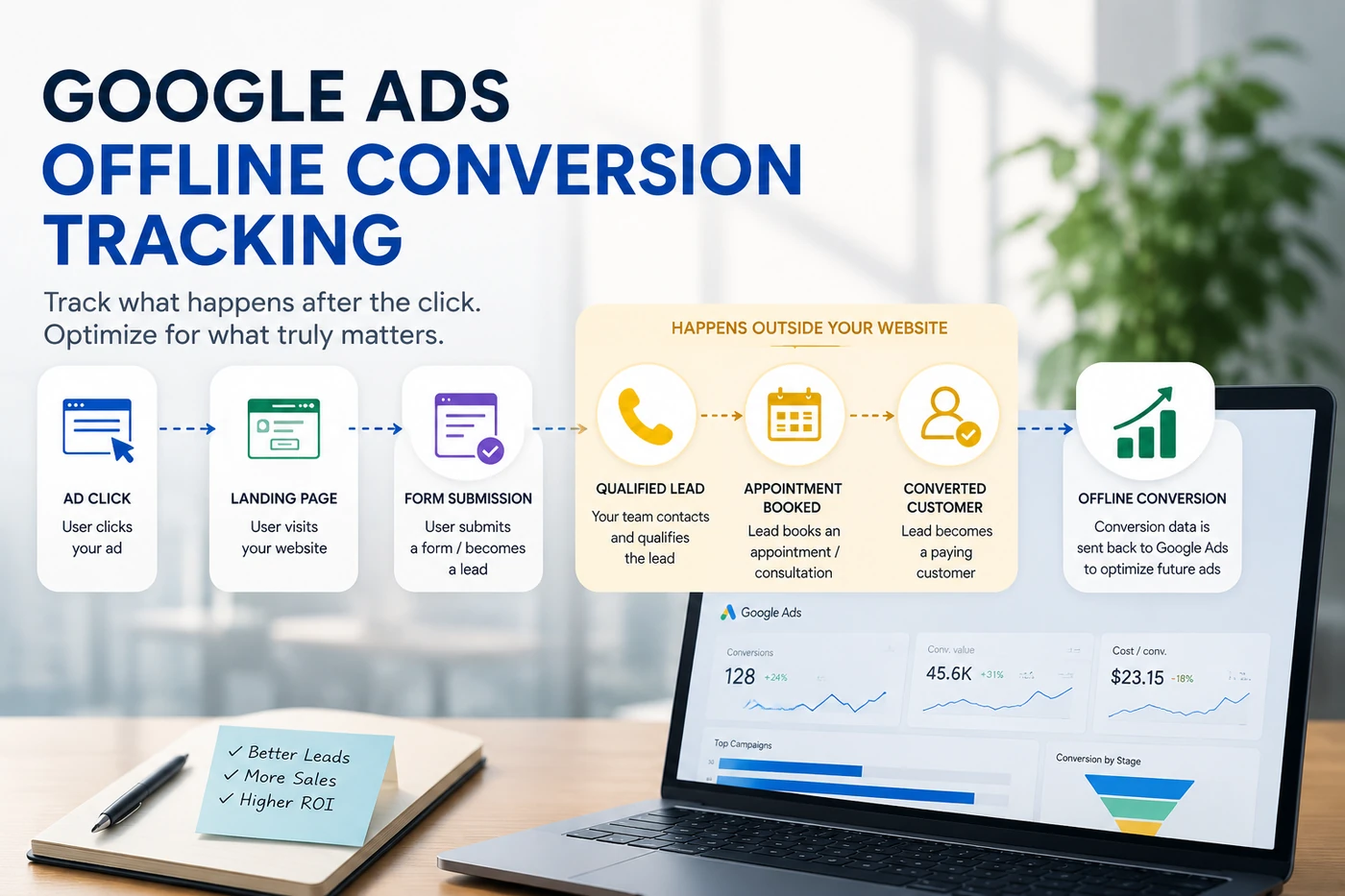
The platform dashboard is not the final judge. For a lead-generation business, a low-cost form submission that never answers the phone is not necessarily a good conversion. For e-commerce, revenue and margin matter more than clicks. This is where offline conversion tracking thinking applies just as much.
These platforms should not be treated as interchangeable.
For most advertisers, the right question is not “Which platform wins?” It is “Which part of the customer journey should each platform handle?”
Google can remain the foundation for proven search demand. Meta can introduce the offer and create demand. ChatGPT can become a test channel for reaching people while they are describing a problem or comparing options in more detail.
For a deeper side-by-side analysis, read ChatGPT Ads vs Google Ads vs Meta Ads.
The platform may be worth testing when:
Potential use cases include software, e-commerce products that require comparison, professional services, education, travel, home services, and other categories where people ask detailed questions before taking action. Eligibility and policy restrictions still need to be checked for the specific advertiser and offer.
I would not rush into ChatGPT Ads if:
Being early is useful only when the basics are ready.
Here is how I would keep an initial test controlled.
The purpose of the first month is not to prove that ChatGPT Ads always works. It is to learn whether your offer, audience situations, creative, landing page, and measurement can produce valuable outcomes on this channel.
They are broad relevance signals, not a promise that the ad will appear for one specific phrase.
This weakens the relationship between context hints, creative, and landing page.
Create real variations that speak to different needs, benefits, and objections.
Use the page that best continues the specific promise made in the ad.
If the platform cannot see the right outcome, conversion-focused optimization has a weak foundation.
A click is useful only if it has a reasonable chance of becoming valuable business.
Search keywords and conversational context are not the same input. Rebuild the structure around customer situations.
Early results can be noisy. Look for repeatable evidence before making a large budget decision.
ChatGPT Ads give advertisers access to a different moment in the customer journey: the point where someone may be explaining a need, exploring options, and working toward a decision.
That is valuable. It is also easy to overstate.
The platform is still evolving, and the right approach is disciplined testing. Start with a clear goal, focused ad groups, thoughtful context hints, useful creative, a relevant landing page, and conversion tracking you trust. Then judge the campaign by qualified outcomes, not novelty.
I would not replace a profitable Google or Meta campaign just to say a business is “early” to ChatGPT Ads. I would test ChatGPT as an additional channel, compare its customer quality and economics, and scale only if the numbers justify it.
We can help with campaign structure, context hints, measurement, creative, and ongoing optimisation, alongside your existing Google and Meta accounts.
Adzlance ChatGPT Ads management →Five questions advertisers ask most often. Use the arrows or dots to move between them.
ChatGPT Ads appear as clearly labeled placements below ChatGPT responses. Delivery can consider the current conversation's context and intent, the ad and landing page, advertiser-supplied context hints, bids, and other supported signals.
Gurdeep Singh is the founder of Adzlance, a paid media agency specializing in Google Ads, Meta Ads, ChatGPT Ads, conversion tracking and performance-focused advertising.
Platform facts accurate as of 17 August 2026. ChatGPT Ads is in beta and changes frequently, check OpenAI's own documentation before planning a budget.
Practical writing on paid media, based on real account work.