
Healthcare practices can get more patients with Google Ads by targeting searches that show a need for care, matching campaigns to specific services and locations, and measuring booked appointments rather than counting every call or form as a success. Strong campaigns make it easy for a prospective patient to confirm that the practice provides the right service, accepts suitable patients, serves their area, and offers a clear way to request an appointment.

In this guide
- Why Can Google Ads Work for Healthcare Practices?
- Which Healthcare Services Should Have Separate Campaigns?
- How Should Healthcare Practices Choose Keywords?
- How Should Location Targeting Be Set Up?
- What Should Healthcare Search Ads Say?
- What Google Ads Policies Affect Healthcare Advertising?
- Why Do Healthcare Landing Pages Matter?
- How Should Calls and Appointment Requests Be Tracked?
- What Does the Healthcare Case Study Show?
- How Much Should a Healthcare Practice Spend?
- Why Do Healthcare Google Ads Get Clicks but Not Patients?
- A Practical Healthcare Google Ads Plan
- Turn Patient Intent Into Appointments
- Frequently Asked Questions
Adzlance provides Google Ads management services for healthcare and other appointment-based businesses that want advertising connected to real outcomes. If your practice is new to paid search, our Google Ads guide for small businesses explains the broader foundation behind campaign structure, bidding, and measurement.
Why Can Google Ads Work for Healthcare Practices?
Many healthcare searches begin with a specific need. A person may look for a dermatologist accepting new patients, an emergency dentist, a nearby physical therapist, or a particular clinic service.
Google Search can place the practice in front of that person while they are actively comparing options. Visibility alone does not create a new patient. The campaign must align five elements:
The patient’s search and intent
The service the practice genuinely offers
The location and appointment availability
A trustworthy landing page
Accurate measurement of appointment outcomes
When one element is missing, a practice may receive clicks without gaining suitable appointments.
Which Healthcare Services Should Have Separate Campaigns?
Avoid placing every treatment, provider, and location into one broad campaign. Different services have different patient needs, eligibility requirements, urgency, and appointment values.
| Campaign theme | Example search intent | Recommended destination |
|---|---|---|
| Dermatology appointment | Looking for evaluation or treatment | Dermatology service page with appointment request |
| Emergency dental care | Immediate dental problem | Emergency dentistry page with visible phone option |
| Physical therapy | Seeking help for a specific condition or recovery need | Relevant therapy service page |
| Primary care | Looking for an ongoing healthcare provider | New-patient primary care page |
| Specialist consultation | Comparing local specialists | Specialty page with provider credentials and next steps |
Separate campaigns make budgets, search terms, ads, landing pages, and results easier to evaluate.
How Should Healthcare Practices Choose Keywords?
Start with searches that indicate a person is looking for a provider, service, or appointment. The strongest keywords usually combine a service with local or action-based intent, such as:
dermatologist accepting new patients
emergency dentist near me
physical therapy appointment
primary care doctor in a specific city
specialist consultation near me
Broader symptom searches can have unclear intent. Test them carefully rather than giving them the same budget as provider-focused queries.
Review the search terms report regularly. Depending on the practice, negative keywords may be needed for jobs, salaries, courses, definitions, free care, research studies, services not offered, insurance plans not accepted, and locations outside the service area.
How Should Location Targeting Be Set Up?
Most healthcare practices draw patients from a realistic travel area. Targeting an entire state may create unnecessary spending when patients will only travel 10 or 20 miles for routine care.
Google Ads allows location targeting by city, ZIP code, radius, region, and other geographic areas. For a local practice, Google’s Presence location option is often a sensible starting point because it focuses on people in or regularly in the targeted area. Google also states that location targeting uses several signals and is not completely accurate, so geographic reports still need regular review.
Build the service area around how far suitable patients actually travel. A specialist may attract patients from farther away than a general dentist or primary care clinic.
What Should Healthcare Search Ads Say?
A useful healthcare ad should help the prospective patient make a safe, informed next step. Depending on the service, it may include:
The exact specialty or appointment type
The clinic location
New-patient availability, when accurate
Accepted insurance information, when verified
Relevant provider credentials
A clear call or appointment action
Avoid unsupported promises, guaranteed outcomes, exaggerated urgency, and language that appears to diagnose the person. The ad should describe the service and access to care without implying that Google or the advertiser knows a user’s private health situation.
The landing page must support every important claim, including insurance participation and appointment availability.
What Google Ads Policies Affect Healthcare Advertising?
Healthcare advertising requires more policy awareness than many local industries. Google’s Healthcare and medicines policy states that some content cannot be advertised, while other categories are allowed only in certain locations or after certification.
Restrictions may apply to areas such as:
Online pharmacies and prescription drug services
Telemedicine services involving prescribing
Addiction treatment services
Clinical trial recruitment
Experimental treatments
Prescription drug terms
Health insurance advertising
Certain reproductive-health services
A local medical, dental, dermatology, or therapy campaign may not need the same certification as a pharmacy or prescription-focused telemedicine provider. Check the rules for the exact service and location before launching.
Google also applies personalized-advertising restrictions to sensitive health interests. This limits how health-related audiences and user data can be used for targeting. Search campaigns built around a person’s current query are therefore often a clearer starting point than trying to follow users based on inferred medical conditions.
Why Do Healthcare Landing Pages Matter?
A healthcare landing page must reduce uncertainty. Sending every visitor to a general homepage forces the person to search again for the service they already requested.
A focused page should make the following easy to find:
The service provided and who it is for
The practice location and hours
Provider names and relevant credentials
New-patient or referral requirements
Insurance and payment information, when available
A visible phone number or appointment form
What happens after the request is submitted
Use plain language and a mobile-friendly layout. Ask only for information needed at the first step, and have appropriate advisers review how health information is collected, transmitted, stored, and shared.
How Should Calls and Appointment Requests Be Tracked?
Google Ads supports phone call conversion tracking from ads and from numbers displayed on a website. Advertisers can set a minimum call duration before a call is counted as a conversion, but call length does not prove that an appointment was appropriate or booked.
The measurement process should distinguish:
Phone calls and form submissions
Qualified prospective patients
Appointments requested
Appointments booked
Appointments attended
New patients or completed services
Where permitted and configured appropriately, useful offline outcomes can be connected back to advertising. Do not upload unnecessary patient details or sensitive medical information. Healthcare practices should confirm that their tracking, consent, contracts, and data handling meet applicable legal and platform requirements.
Our guide to Google Ads offline conversion tracking explains why downstream outcomes are more useful than stopping at the initial lead.
What Does the Healthcare Case Study Show?
The anonymized healthcare dashboard covers the displayed period from April 13 to August 31, 2026. It reports:
$44.01 cost per tracked conversion
1.02K conversions
3.27K phone calls
11.21% conversion rate
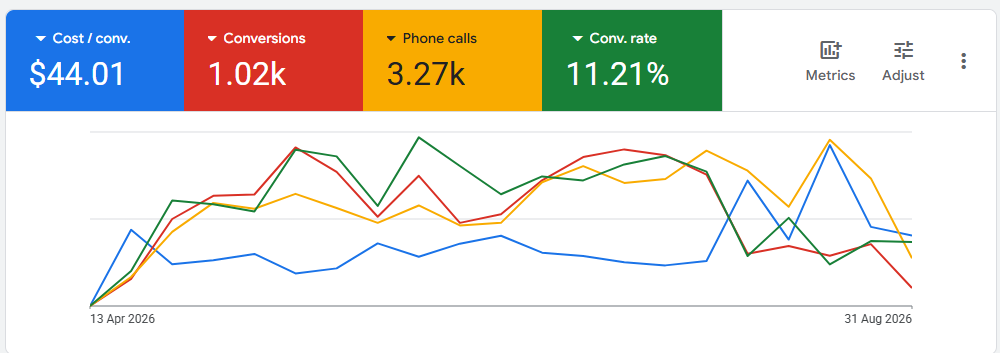
These figures show that the account generated substantial measurable activity at the reported conversion cost. They do not reveal how many calls became qualified enquiries, booked appointments, attended appointments, or new patients. Phone calls and conversions must also remain separate because the dashboard displays them as different metrics and they may overlap.
The $44.01 conversion cost is not a forecast for every practice. The practical lesson is that call and conversion tracking make it possible to evaluate advertising beyond clicks. Reporting should then connect those actions with appointment and patient outcomes.
How Much Should a Healthcare Practice Spend?
There is no universal healthcare advertising budget. The correct starting point depends on local click costs, specialty, location, appointment capacity, conversion rate, qualification rate, attendance rate, and the value of a new patient.
Work backward from the practice’s economics:
Maximum affordable lead cost = maximum affordable patient acquisition cost multiplied by lead-to-new-patient rate
If a practice can afford $300 to acquire a new patient and 30 percent of qualified enquiries become new patients, its maximum affordable qualified-lead cost would be $90. This is a planning example, not a benchmark or promise.
Before scaling, verify that conversions represent suitable patients and that the front desk can respond quickly enough to book them.
Why Do Healthcare Google Ads Get Clicks but Not Patients?
Common causes include:
Keywords focused on research instead of appointments
Ads promoting services or insurance options that do not match the page
Targeting people outside the practical patient area
Sending every click to the homepage
Complicated forms or weak mobile usability
Missed calls and slow follow-up
Limited appointment availability
Counting every call as a successful patient lead
Policy disapprovals that restrict important ads or keywords
The advertising account may appear busy while the appointment calendar remains unchanged. An audit should examine search terms, location data, calls, forms, landing pages, scheduling response, and downstream patient outcomes together.
If that connection is unclear, request a free Google Ads audit before increasing the budget.
A Practical Healthcare Google Ads Plan
Choose one priority service. Start where the practice has capacity and a clear patient need.
Define the suitable patient area. Base targeting on real travel behavior and clinic locations.
Use provider and appointment intent. Prioritize searches from people actively seeking care.
Create a focused landing page. Match the service, location, eligibility, and next step.
Review policy requirements. Confirm whether the service requires certification or has targeting restrictions.
Measure appointment quality. Connect calls and forms with booked and attended appointments.
Improve the full patient journey. Fix response time and scheduling barriers before buying more traffic.
Turn Patient Intent Into Appointments
Google Ads can help healthcare practices attract more patients when campaigns are built around genuine service intent, practical locations, compliant messaging, trustworthy landing pages, and appointment-level measurement.
Clicks and form submissions are only the beginning. The meaningful outcome is a suitable patient who books and attends an appointment. That requires coordination between the advertising account, website, front desk, scheduling process, and compliance requirements.
If your practice is paying for clicks but cannot see which campaigns create real appointments, Adzlance can review the account and build a clearer healthcare Google Ads strategy around your services, locations, and patient-acquisition goals.
Frequently Asked Questions
Do Google Ads work for healthcare practices?
Yes. Google Ads can reach people actively searching for providers, services, and appointments. Results depend on search intent, competition, location, landing pages, availability, policy compliance, tracking, and follow-up.
Can medical practices advertise on Google?
Many medical practices can advertise eligible services. Some healthcare categories, products, treatments, and locations have restrictions or certification requirements, so every service should be checked against current Google Ads policies.
What keywords should healthcare practices target?
Start with keywords that combine a specialty or service with provider, appointment, or local intent. Use search-term data to remove irrelevant research, employment, training, and out-of-area traffic.
Should healthcare ads send patients to the homepage?
Usually not. A focused service page makes it easier to confirm the treatment, provider, location, eligibility, insurance information, and next appointment step.
How should healthcare leads be measured?
Track calls and forms, then distinguish qualified enquiries, booked appointments, attended appointments, and new patients. Avoid using sensitive medical details unnecessarily in advertising systems.
Are healthcare remarketing campaigns allowed?
Health-related personalized advertising is restricted. Whether a campaign is allowed depends on the service, content, targeting method, location, and current Google policies. Review the policy before using audience-based tactics.
More practical Google Ads guides
Continue with practical guides to campaign planning, budgeting, and choosing the right campaign type.