
The choice between Performance Max vs Search campaigns comes down to control, coverage, data quality, and what your customer does before converting. Search is usually the stronger starting point when people actively look for a specific service and you need tight control over queries and messaging. Performance Max can add value when reliable conversion data and good creative assets are available and you want Google to find customers across more of its inventory. If you need help choosing the right structure, Adzlance provides Google Ads management services for lead-generation and e-commerce businesses.
My practical answer is rarely “replace Search with Performance Max.” In many accounts, the better setup is to give each campaign a clear job: Search captures defined demand, while Performance Max expands reach and finds additional conversion opportunities.
What Is the Main Difference Between Performance Max and Search?
A Search campaign primarily reaches people through Google Search and related search inventory. Advertisers organize keywords, ads, negatives, audiences, locations, bids, and landing pages around specific search intent.
Google describes Performance Max as a goal-based campaign type that can access inventory across Search, Shopping, YouTube, Display, Discover, Gmail, and Maps from one campaign. Google uses automation to decide where an ad should appear, which assets to combine, and which users are most likely to complete the selected conversion goal.
| Area | Search campaigns | Performance Max |
|---|---|---|
| Core strength | Capturing known search demand | Expanding across Google channels |
| Targeting foundation | Keywords, match types and search intent | Goals, audience signals, assets, feeds, URLs and automation |
| Creative | Mainly text-led Search ads | Text, images, video, product feeds and other assets |
| Control | Greater query and message control | Broader automation with fewer granular decisions |
| Best starting fit | High-intent services and focused offers | E-commerce, mature accounts and broader growth |
Search campaigns also use automation, broad match, Smart Bidding and optional AI Max features. Performance Max now includes controls such as search themes, brand exclusions and campaign-level negative keywords. The difference is therefore the degree and location of control, not “manual versus automated.”
When Is a Search Campaign the Better Choice?
Search is often the better first campaign when customers already know what they need and express it clearly.
You sell an urgent or specific service
A plumber, dentist, lawyer, HVAC company or medical practice can build campaigns around high-intent searches such as “emergency plumber near me” or “book a dermatologist appointment.” The business can match the ad and landing page to that need.
That visibility is useful when every lead matters. You can review which search terms generated traffic, add negative keywords, separate services, and write ads for different intent levels.
Your budget is limited
With a smaller budget, I usually prefer to prove one focused demand segment before paying for broader discovery. Search does not guarantee efficiency, but it gives you a clearer view of what people searched and which themes consumed the budget.
Our guide to Google Ads costs for small businesses explains how CPC, conversion rate and customer value should shape the starting budget.
Your offers need different messages
Suppose an HVAC company offers repairs, installations and maintenance plans. Those services have different urgency, margins and landing pages. Search campaigns make it easier to separate them and control the message attached to each query theme.
You are fixing unreliable tracking
Performance Max depends heavily on the conversion goals you provide. If form submissions are duplicated, phone calls are missing, or low-value actions are marked as primary conversions, automation may optimize toward the wrong outcome. Search is not immune to bad tracking, but its traffic is easier to inspect while measurement is being repaired.
When Is Performance Max the Better Choice?
Performance Max becomes more useful when the business has enough information and creative material to let Google optimize beyond a narrow Search campaign.
You run an e-commerce business with a strong product feed
For retailers, Performance Max can use Merchant Center data to serve products across Shopping and other eligible inventory. It can be especially useful when a store has clear product data, accurate prices and availability, meaningful conversion volume, and values that reflect actual revenue.
Automation cannot repair inaccurate titles, missing identifiers, weak images or an account that treats every product as equally profitable.
You want reach beyond active searches
Some customers do not convert from the first search. Performance Max can reach potential buyers across video, display, discovery, Gmail, Maps, Shopping and Search placements. This broader coverage can help when the buying journey involves research or repeated consideration.
Your account already has trustworthy conversion data
Performance Max is more likely to make useful decisions when conversion tracking represents real business value. For lead generation, that may mean importing qualified leads or closed sales instead of optimizing only for every form submission. For e-commerce, transaction values should be accurate and returns or cancellations should be understood.
You have enough creative variety
A complete asset group should give Google relevant text, images and video for the offer. If the only image is a logo and the only headline is generic, the campaign has little to work with. Better automation still needs strong inputs.
Should Small Businesses Start With Search or Performance Max?
For many small service businesses, I would start with Search. It provides a more controlled way to test whether customers are actively looking for the offer, whether the landing page converts, and what a qualified lead costs.
Performance Max may be appropriate earlier for an e-commerce store with an established Merchant Center feed and purchase tracking. Even then, I would not launch it simply because Google recommends the campaign type. Product margin, average order value, brand traffic and existing demand still affect the result.
The complete Google Ads guide for small businesses covers tracking, landing pages, bidding and budget.
Can Search and Performance Max Run Together?
Yes. Google describes Performance Max as a complement to keyword-based Search campaigns, and this is how I generally prefer to use it.
A service business might use Search for its most valuable, clearly defined queries and Performance Max to explore additional reach once the account has trustworthy data. An online retailer might use Performance Max for product-led growth while keeping Search campaigns for brand terms, important categories, competitors where appropriate, or high-value queries that need distinct messaging.
Define the role of brand traffic, confirm budgets are not restricting the campaign you expect to serve, and evaluate incremental business value rather than platform-reported conversions alone.
Which Campaign Takes Priority When Both Are Eligible?
Google uses campaign and asset-group prioritization rules. If a user's search is identical to an eligible exact-match keyword in a Search campaign, that Search campaign is generally prioritized over Performance Max. If no eligible keyword exactly matches the query, the campaign or ad with the higher Ad Rank may serve.
Search themes in Performance Max behave with the same priority as phrase- and broad-match Search keywords. They are optional signals that help Google understand queries relevant to the business; they are not exact keywords that force delivery.
A Search campaign restricted by budget, targeting, low search volume or other eligibility issues may not enter the auction as expected. Validate the structure through actual reports.
How Do You Stop Performance Max From Taking Brand Traffic?
Brand traffic can make a campaign look stronger because people already searching for the company are often easier to convert. If the goal is to measure non-brand growth separately, use the controls designed for that purpose.
Google recommends brand exclusions to prevent Performance Max from serving on selected branded queries. Campaign-level or account-level negative keywords may also be appropriate, depending on the requirement. Google notes that Performance Max negative keywords apply to Search and Shopping inventory, not every channel.
After applying exclusions, monitor search terms insights and campaign reporting.
What Are the Biggest Performance Max Mistakes?
- Using every conversion action as a goal. Page views or unqualified contacts can send automation in the wrong direction.
- Launching without useful assets. Weak creative limits the quality and relevance of combinations Google can serve.
- Treating audience signals as strict targeting. Signals guide learning but do not necessarily limit delivery to those users.
- Ignoring branded traffic. Strong brand conversions can hide weak acquisition performance.
- Combining unrelated products or services. Mixed economics and landing pages make performance harder to diagnose.
- Judging only by ROAS or CPA inside Google Ads. Lead quality, profit, repeat purchases and incremental revenue still matter.
- Making large changes too quickly. Constant restructuring makes it difficult to understand what actually improved results.
How Should You Compare Performance Fairly?
Start with conversion quality. A Search campaign generating 20 qualified calls may be more valuable than a Performance Max campaign reporting 40 actions that include weak forms, directions or existing customers.
Compare cost per qualified lead, customer acquisition cost, revenue, profit and ROAS where those figures are reliable. Separate brand and non-brand contribution. For lead generation, send offline outcomes back to Google Ads so the system can distinguish a submitted form from a genuine opportunity or customer.
Search may capture the final high-intent click, while Performance Max introduces or re-engages the customer elsewhere. Attribution adds context, but business results should make the final decision.
My Recommended Starting Framework
- Fix conversion tracking first. Make sure primary goals represent valuable actions.
- Start with the clearest demand. For many service businesses, that means focused Search campaigns.
- Build exclusions and campaign roles. Decide how brand, existing customers and low-value traffic should be handled.
- Prepare strong inputs. Improve landing pages, feeds, audience data and creative assets.
- Add Performance Max with a defined purpose. Expansion is a purpose; “Google suggested it” is not.
- Measure qualified outcomes. Optimize toward customers and profit, not the largest conversion count.
Performance Max is not automatically better because it reaches more channels, and Search is not automatically better because it provides more control. The right campaign is the one that matches the buying journey and can be measured honestly.
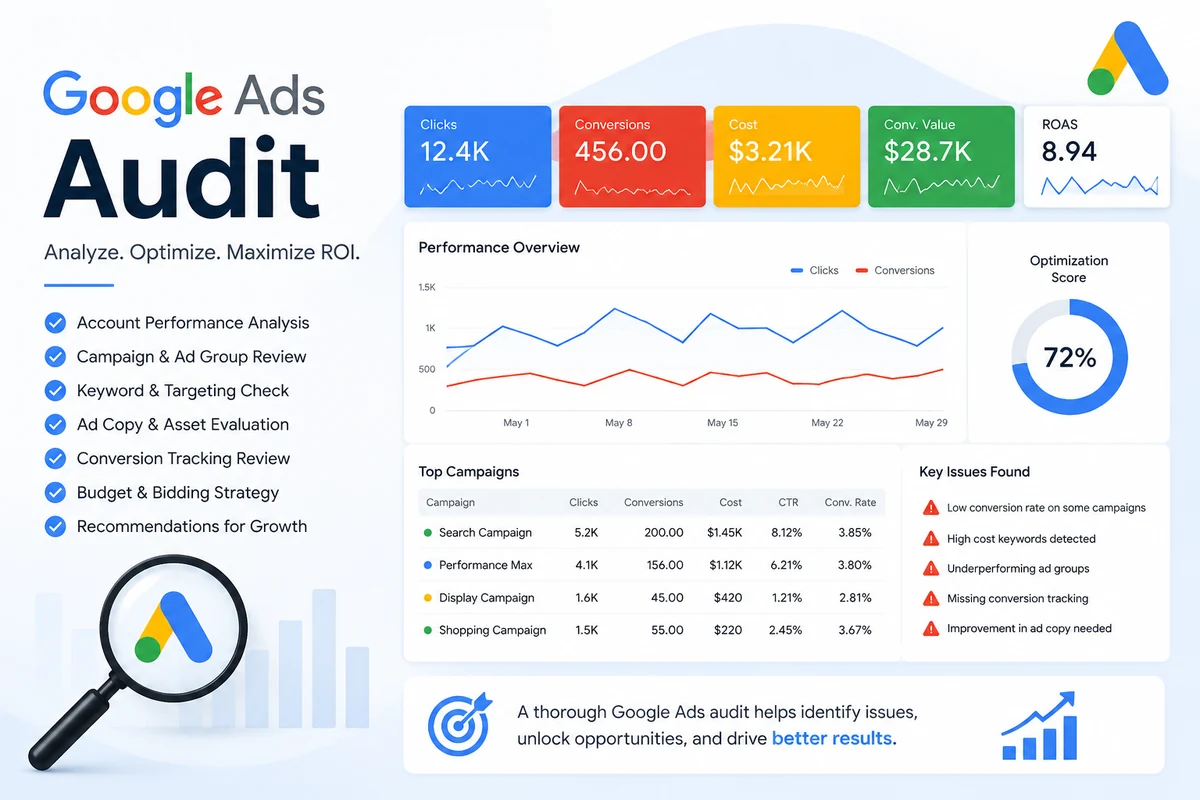
If your account has both campaign types but you cannot tell which one is creating profitable customers, request a free Google Ads audit. Adzlance can review campaign roles, conversion goals, brand traffic, search terms, asset groups and budget allocation before you scale.
Not sure which campaign should get your next dollar?
Adzlance can review your campaign roles, conversion goals, brand traffic, search terms, asset groups and budget allocation before you scale.
Request a free Google Ads audit →Frequently Asked Questions
Is Performance Max better than Search campaigns?
Not universally. Performance Max is stronger for multi-channel reach and automated expansion, while Search is often better for controlled high-intent demand. The right choice depends on the business model, tracking, budget, assets and buying journey.
Does Performance Max replace Search campaigns?
No. Google positions Performance Max as complementary to keyword-based Search. Many accounts benefit from using Search for defined queries and Performance Max for broader incremental opportunities.
Can Performance Max show on Google Search?
Yes. Performance Max can serve on Search as well as Shopping, YouTube, Display, Discover, Gmail and Maps inventory.
Which campaign is better for lead generation?
Search is often the safer starting point for focused lead-generation services. Performance Max can work when conversion tracking includes qualified offline outcomes and the campaign has strong assets, exclusions and landing pages.
Which campaign is better for e-commerce?
Performance Max can be effective for e-commerce because it uses Merchant Center product data and accesses multiple channels. Search remains useful for specific brand, category and high-value query strategies.
Can I use negative keywords in Performance Max?
Yes. Google supports campaign-level and account-level negative keyword controls. Performance Max campaign negatives apply to Search and Shopping inventory. Brand exclusions are usually the more complete control for blocking selected branded searches.
How long should I test Performance Max?
There is no universal number of days. The campaign needs enough time and conversion volume to produce meaningful evidence, but poor tracking should be fixed immediately. Set the test around a realistic conversion cycle and budget rather than waiting indefinitely.
About the author
Gurdeep Singh is the founder of Adzlance, a paid media agency specializing in Google Ads, Meta Ads, ChatGPT Ads, conversion tracking and performance-focused advertising.
Platform information reviewed against official Google Ads documentation on 3 September 2026. Campaign features and controls may change over time.
For product feeds, margins, and purchase measurement, read how ecommerce brands can increase sales with Google Ads.
More Google Ads Guides
Continue with practical guides for budgeting, campaign planning and account auditing.