In this guide
- Why Can Google Ads Work Well for HVAC Companies?
- Which HVAC Services Should Have Separate Campaigns?
- How Should HVAC Keywords Be Selected?
- How Should Location Targeting Be Configured?
- What Should HVAC Search Ads Say?
- Why Do HVAC Landing Pages Affect Lead Volume?
- What Do the Real HVAC Campaign Screenshots Show?
- How Should HVAC Phone Calls Be Tracked?
- Should HVAC Companies Use Search or Performance Max?
- How Much Should an HVAC Company Spend on Google Ads?
- What Causes HVAC Google Ads to Waste Money?
- A Practical HVAC Google Ads Lead Plan
- Turn HVAC Ad Spend Into Qualified Leads
- Frequently Asked Questions
HVAC companies can get more qualified leads with Google Ads by targeting urgent service searches, separating campaigns by job type, restricting ads to real service areas, and tracking phone calls correctly. The goal is not to generate the largest number of clicks. It is to turn advertising spend into booked repair, replacement, and maintenance jobs. Adzlance provides Google Ads management services for HVAC and other local service businesses that want campaigns managed around genuine customer outcomes.
HVAC advertising can become expensive when contractors compete for the same high-intent searches. Strong campaigns concentrate budget where the search, service, location, and landing page match closely.
Why Can Google Ads Work Well for HVAC Companies?
HVAC demand is often immediate. A homeowner with a broken air conditioner during summer or a failed furnace during winter is not casually browsing. They need a nearby company that can respond.
Google Search can place an HVAC company in front of that customer while the need is being expressed. Profitability still depends on accurate targeting, relevant messaging, reliable call handling, and conversion tracking.
Which HVAC Services Should Have Separate Campaigns?
Do not place every service into one generic campaign. Repair, installation, replacement, and maintenance searches have different urgency, value, and sales cycles.
| Campaign theme | Example customer intent | Recommended destination |
|---|---|---|
| Emergency AC repair | Immediate cooling problem | AC repair landing page with prominent call option |
| Furnace repair | Heating system not working | Heating repair page |
| HVAC replacement | Comparing a higher-value purchase | Replacement or estimate page |
| Heat pump installation | Researching a specific system | Dedicated heat pump page |
| Maintenance and tune-ups | Preventive or seasonal service | Maintenance-plan page |
Separating these themes makes budgets and messages easier to control and protects money intended for urgent repairs or replacement leads.
How Should HVAC Keywords Be Selected?
Start with searches that indicate a service need, not broad curiosity. Examples may include “AC repair near me,” “furnace repair company,” “heat pump installer,” or “HVAC replacement estimate.” Location terms can be useful, but Google already uses location signals, so adding every ZIP code as a keyword is rarely necessary.
Review the search terms report frequently. A keyword can match searches that are less relevant than expected. Depending on the services offered, exclusions may be needed for:
- DIY instructions and troubleshooting guides
- Jobs, salaries, training, and certification searches
- Parts, manuals, and wholesale equipment
- Services the company does not provide
- Cities outside the service area
- Free or very low-intent research queries
Negative keywords should protect the budget without blocking genuine customers who describe a problem differently.
How Should Location Targeting Be Configured?
HVAC companies normally have a defined service area. Paying for clicks from places the team cannot reach is avoidable waste.
Google Ads allows advertisers to target cities, ZIP codes, regions, and radius areas. The default location option can include people who show interest in the targeted area, even if they are not physically there. For a local HVAC campaign, the Presence option is often a safer starting point because it focuses on people in or regularly in the selected locations. Google notes that location targeting is based on multiple signals and is not guaranteed to be 100 percent accurate, so location reports still need to be reviewed.
Build targeting around real dispatch capacity. An oversized radius can create long travel times, late arrivals, and lower booking rates.
What Should HVAC Search Ads Say?
The ad should confirm the service and make the next step easy. Useful information can include:
- The exact repair or installation service
- The city or service area
- Availability, only when the business can honor it
- Licensing, warranties, financing, or reviews when verified
- A direct call or booking action
Avoid unsupported claims such as “best service.” Keep call coverage aligned with ad schedules. Advertising 24/7 service when nobody can answer creates wasted calls.
Why Do HVAC Landing Pages Affect Lead Volume?
Sending every ad to the homepage makes the visitor search again for the service they already requested. A dedicated landing page should continue the same message as the keyword and ad.
For an AC repair campaign, the page should quickly show:
- AC repair as the main service
- The areas covered
- A visible phone number and short form
- Trust signals that are accurate
- What happens after the customer contacts the company
- A layout that works properly on mobile
Our Google Ads guide for small businesses explains how campaign structure, landing pages, bidding, and tracking work together.
What Do the Real HVAC Campaign Screenshots Show?
The supplied Google Ads screenshots cover an anonymized HVAC and water-heating account over the displayed period from December 29, 2025 to June 29, 2026.
The account-level view reports:
- 82 phone calls
- 50 tracked conversions
- Approximately $5,200 in advertising cost
- $104 average cost per tracked conversion
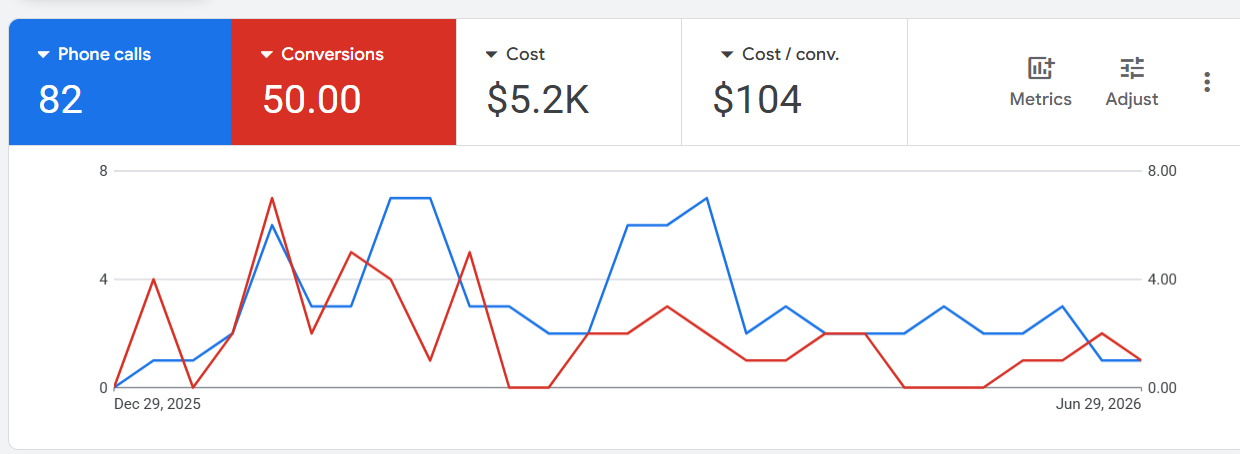
These metrics should remain separate. “Phone calls” and “conversions” are different columns in the supplied view, so adding them together would risk double counting. The screenshot also does not show how many calls became booked jobs or paying customers. The result demonstrates lead activity at a measurable acquisition cost, but profitability still depends on lead quality, booking rate, job value, gross margin, and close rate.
The device and campaign view adds another useful detail. In the visible rows, the Water Heaters Display Max campaign recorded 30 mobile-phone conversions at $42.03 per conversion and four computer conversions at $50.66. Visible Search rows had fewer conversions and higher costs per conversion, including $217.55, $151.43, $271.01, and $401.17.
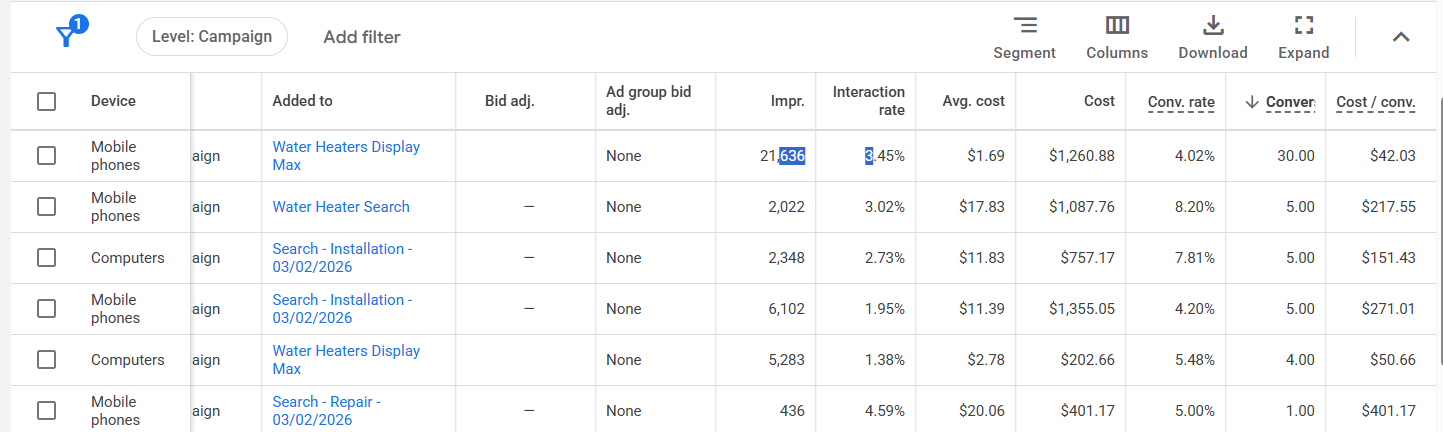
“Water Heaters Display Max” is the campaign name shown in the screenshot; the name alone does not establish its Google Ads campaign type. These rows do not prove that one campaign type is always better than another. It shows that this campaign and device combination produced cheaper tracked actions during this period. Before shifting budget, verify what each conversion represented and compare booked-job quality.
How Should HVAC Phone Calls Be Tracked?
Calls are often the most valuable conversion for urgent HVAC work, but not every call has the same value. A wrong number, supplier call, existing customer, or 20-second enquiry should not be treated like a booked replacement estimate.
Google Ads can track calls from ads and calls to phone numbers on a website. The Google tag can also be used with a phone snippet on selected pages. Configure meaningful call-duration rules, but remember that duration is only a proxy for quality.
The better measurement process is:
- Track calls and forms accurately.
- Record whether the lead was qualified.
- Record whether an appointment was booked.
- Record whether the job was completed and its value.
- Send useful offline outcomes back to the advertising platform where possible.
Connecting website, analytics, CRM, and offline outcomes can help bidding distinguish a ringing phone from actual revenue.
Should HVAC Companies Use Search or Performance Max?
Search is often the clearest starting point for urgent, service-specific demand because the business can organize keywords and ads around repairs, installations, and locations.
Performance Max can add reach when the account has accurate goals, useful assets, and reliable data. It should have a defined role.
The real account screenshots show why both campaign type and measurement matter. One campaign produced lower-cost tracked actions in the visible rows, but a campaign manager still needs to confirm that those actions became valuable leads.
Read our practical comparison of Performance Max and Search campaigns before deciding how each should be used.
How Much Should an HVAC Company Spend on Google Ads?
There is no universal HVAC budget. A realistic amount depends on local click costs, service-area demand, expected conversion rate, booking rate, average job value, margin, and the number of leads needed.
Work backward from business economics:
Maximum affordable cost per lead = maximum affordable customer acquisition cost multiplied by lead-to-customer close rate
If a company can afford $500 to acquire a new customer and closes 25 percent of qualified leads, the maximum affordable qualified-lead cost would be $125. This is a planning example, not a benchmark or guarantee.
The existing account screenshot shows a $104 cost per tracked conversion, but that figure should not be copied into another HVAC company's forecast. Markets, services, seasons, competitors, and conversion definitions differ.
Use our Google Ads cost guide for small businesses to calculate a starting budget from your own numbers.
For service-specific spending scenarios and lead-cost calculations, read our guide to HVAC Google Ads costs.
What Causes HVAC Google Ads to Waste Money?
- Combining repairs, replacements, maintenance, and unrelated services in one campaign
- Using broad geographic targeting beyond the dispatch area
- Ignoring actual search terms and negative keywords
- Sending every visitor to the homepage
- Running call-focused ads when nobody can answer
- Counting weak actions as primary conversions
- Optimizing for lead quantity without checking booking quality
- Increasing budgets before fixing tracking or campaign structure
- Leaving seasonal budgets unchanged when demand shifts
A Practical HVAC Google Ads Lead Plan
- Separate campaigns by service value and urgency. Keep repair, installation, and maintenance budgets visible.
- Target the real service area. Use location settings and exclusions that match dispatch capacity.
- Build around high-intent searches. Review search terms instead of relying only on the keyword list.
- Match ads and landing pages. Carry the same service promise from the search to the page.
- Make calling easy. Use mobile-friendly pages, call assets, and accurate business hours.
- Track qualified outcomes. Connect calls and forms to appointments, jobs, and revenue.
- Move budget using evidence. Compare lead quality and customer value, not only the lowest cost per conversion.
Turn HVAC Ad Spend Into Qualified Leads
Google Ads can generate HVAC leads when the campaign is built around the way customers actually request service. The strongest accounts connect high-intent searches with the correct service area, a clear message, a focused landing page, responsive call handling, and accurate conversion measurement.
The supplied account recorded 50 tracked conversions from approximately $5,200 in spend at an average cost of $104 per conversion, alongside 82 reported phone calls. These results are evidence, not a promise. The next question is whether those leads became profitable jobs.
If your HVAC campaigns are spending money but you cannot connect the dashboard to real customers, request a free Google Ads audit. Adzlance can review search terms, locations, campaign structure, tracking, landing pages, and lead quality before you increase the budget.
Frequently Asked Questions
Do Google Ads work for HVAC companies?
Yes, Google Ads can generate HVAC enquiries by reaching people searching for repairs, replacements, installations, and maintenance. Profitability depends on targeting, competition, landing pages, tracking, call handling, and close rate.
What are the best Google Ads keywords for HVAC companies?
The best starting keywords usually describe a specific service and buying need, such as AC repair, furnace repair, heat pump installation, or HVAC replacement. Actual value must be confirmed through local search-term and conversion data.
Should HVAC companies target a radius or ZIP codes?
Either can work. Choose locations that match the real service area, technician capacity, travel time, and job economics. Review geographic reports because location targeting is not perfectly accurate.
How can an HVAC company reduce wasted Google Ads spend?
Separate services, tighten location settings, review search terms, add careful negative keywords, improve landing-page relevance, and stop counting low-value actions as primary conversions.
Should HVAC ads send visitors to the homepage?
Usually not. A focused service page makes it easier for the customer to confirm the service, location, availability, and next step without searching through the website.
How should phone calls be measured in HVAC campaigns?
Track the call source and duration, then connect calls to qualified enquiries, appointments, completed jobs, and revenue. Call volume alone does not show business value.
More practical Google Ads guides
Continue with practical guides to campaign planning, budgeting, and choosing the right campaign type.