
Google Ads costs for HVAC companies vary by market, service, season, competition, and lead quality. A practical monthly ad budget may start around $2,000 to $5,000 for a focused local campaign, while businesses covering several services or territories may need more. That is a planning range from Adzlance, not a Google requirement or guaranteed performance level. The right budget should be calculated from the number of qualified leads and booked jobs the company can profitably handle.
In this guide
- What Does an HVAC Company Actually Pay For?
- What Is the Average Cost per Click for HVAC Advertising?
- What Is a Realistic HVAC Cost per Lead?
- How Much Should an HVAC Company Spend Each Month?
- How Is a Google Ads Daily Budget Converted Into Monthly Spend?
- Why Do HVAC Advertising Costs Change by Service?
- How Do You Calculate an Affordable HVAC Lead Cost?
- What Makes HVAC Google Ads More Expensive Than Necessary?
- Should HVAC Companies Use Search or Performance Max?
- How Can HVAC Companies Control Their Google Ads Costs?
- Build Your HVAC Budget Around Profitable Jobs
- Frequently Asked Questions
If you want to understand how campaign structure affects lead volume before setting a budget, read our guide to getting more HVAC leads with Google Ads. Adzlance also provides Google Ads management services for local service businesses that want spending tied to genuine customer outcomes.
What Does an HVAC Company Actually Pay For?
Google Search Ads normally use pay-per-click pricing. You are charged when someone clicks the ad, not simply when it appears. The amount paid for a click is influenced by the auction, competing advertisers, the search, ad quality, landing-page relevance, location, device, and other signals.
The advertising budget is only one part of the total investment. An HVAC company may also pay for:
- Campaign setup or ongoing management
- Landing-page design or development
- Call-tracking software
- CRM or booking-system integration
- Creative assets for Performance Max or remarketing
Keep media spend and professional fees separate when comparing proposals. Media spend goes to Google. Management, tracking, and landing-page costs pay for the work and systems used to improve performance.
What Is the Average Cost per Click for HVAC Advertising?
There is no official Google CPC for HVAC companies. Every click is priced through an auction, and emergency or high-value searches can cost much more than general research queries.
The 2026 LocaliQ search advertising benchmark reports an average CPC of $8.33 for the broader Home and Home Improvement category. The report combines Google Ads and Microsoft Ads campaign data, and that category includes more than HVAC, so it should be treated as directional context rather than an HVAC-specific forecast. A search such as “emergency AC repair near me” may behave very differently from “HVAC maintenance tips.”
Your real cost depends on:
- The city and service radius
- Repair, maintenance, or installation intent
- Seasonal demand and weather
- Mobile versus desktop traffic
- Competitor bids and budgets
- Ad and landing-page relevance
- Match types, search terms, and negative keywords
A lower CPC is not automatically better. A $6 click that never produces a qualified enquiry is more expensive than a $20 click that becomes a profitable replacement job.
What Is a Realistic HVAC Cost per Lead?
Cost per lead equals advertising spend divided by tracked leads. However, that simple calculation is only useful when the account counts meaningful calls and forms.
LocaliQ reports a $90.92 average cost per lead for Home and Home Improvement search advertising in 2026. Again, this is a broad category benchmark, not a promise for HVAC. Different businesses may define a lead differently, and a form submission is not necessarily equal to a booked service call.
An anonymized HVAC and water-heating account supplied to Adzlance recorded the following account-level results during the displayed period from December 29, 2025 to June 29, 2026:
- Approximately $5,200 in Google Ads spend
- 50 tracked conversions
- $104 average cost per tracked conversion
- 82 reported phone calls
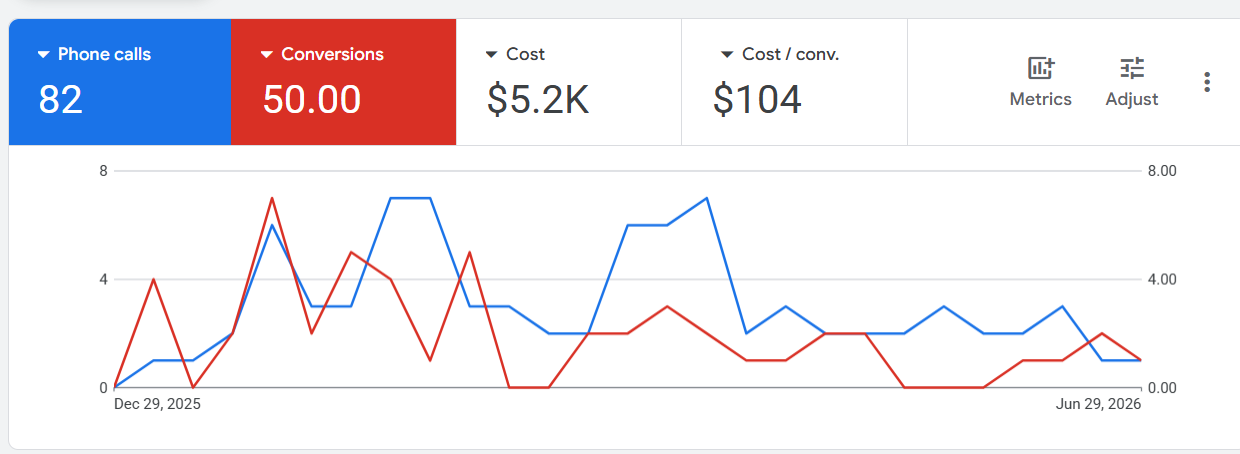
The 82 phone calls and 50 conversions must remain separate because the screenshot shows them as different metrics and they may overlap. The account view also does not reveal how many leads became appointments or completed jobs. The $104 figure is useful first-party evidence, but it should not be copied into another company’s forecast.
How Much Should an HVAC Company Spend Each Month?
The table below provides Adzlance planning scenarios, not platform minimums or guaranteed lead volumes.
| Monthly ad spend | Best suited to | Main limitation |
|---|---|---|
| $1,500 to $2,500 | One focused service in a smaller area | Limited room for several campaigns or expensive searches |
| $2,500 to $5,000 | A local HVAC company testing repair and installation demand | Requires clear priorities and careful geographic control |
| $5,000 to $10,000 | Multiple services, stronger demand, or a broader territory | Tracking and call handling must support the additional volume |
| $10,000+ | Competitive markets, several locations, or aggressive growth | Budget should be governed by qualified leads and customer value |
A small budget can still work when the campaign is narrow. Problems begin when $2,000 is divided among AC repair, furnace repair, replacements, tune-ups, heat pumps, several cities, Search, and Performance Max. Each priority receives too little data and too little budget.
How Is a Google Ads Daily Budget Converted Into Monthly Spend?
Google Ads uses an average daily budget for most campaigns. Google states that most campaigns can spend up to twice the average daily budget on a particular day, while the monthly spending limit is generally 30.4 times the average daily budget.
For example:
| Average daily budget | Approximate monthly limit |
|---|---|
| $50 | $1,520 |
| $100 | $3,040 |
| $165 | $5,016 |
| $250 | $7,600 |
Daily spend may rise when demand is stronger and fall on quieter days. HVAC owners should review monthly pacing rather than assuming the campaign will spend the exact daily amount every day.
Why Do HVAC Advertising Costs Change by Service?
Not every HVAC lead has the same commercial value.
Emergency repairs
Emergency searches often have immediate intent, but competition may be intense. Fast phone response is essential because homeowners may call several companies.
Maintenance and tune-ups
These leads may cost less, but the initial job value can also be lower. Their value may come from maintenance plans, retention, and future repairs.
Replacements and installations
Replacement clicks and leads can be expensive because the potential job value is higher. These campaigns need dedicated landing pages, financing information where applicable, and a process for following up on estimates.
Campaigns should therefore be evaluated by service-level economics, not one blended account average.
How Do You Calculate an Affordable HVAC Lead Cost?
Start with the maximum amount the business can afford to pay for a new customer, then account for the percentage of qualified leads that become customers.
Maximum affordable lead cost = maximum customer acquisition cost multiplied by lead-to-customer close rate
Suppose an HVAC company can afford $500 to acquire a customer and closes 25 percent of qualified leads:
$500 × 25% = $125 maximum affordable qualified-lead cost
This example is not a benchmark. The company should calculate customer value from its own revenue, gross margin, repeat work, financing costs, technician capacity, and service mix.
For replacement campaigns, track completed estimates and sold jobs. For repair campaigns, track booked calls and completed service visits. A platform conversion alone does not confirm profitability.
What Makes HVAC Google Ads More Expensive Than Necessary?
The most common causes are avoidable:
- Targeting locations outside the real service area
- Mixing repairs, maintenance, and installations in one campaign
- Paying for DIY, employment, training, parts, and unrelated searches
- Sending high-intent visitors to a generic homepage
- Running call-focused ads when nobody can answer
- Counting short calls or low-value actions as primary conversions
- Increasing budgets before fixing campaign structure and tracking
- Judging performance only by CPC instead of booked-job economics
A free Google Ads audit can identify where budget is being lost before the company commits to higher spending.
Should HVAC Companies Use Search or Performance Max?
Search is usually the clearest starting point for urgent, service-specific demand. It provides more direct control over search themes, messages, locations, and landing pages.
Performance Max can expand reach across Google inventory, but it needs accurate conversion goals, useful creative assets, and enough reliable data. In the supplied account’s detailed campaign view, visible Water Heaters Display Max rows had lower costs per tracked conversion than several visible Search rows. “Water Heaters Display Max” is the campaign name shown; its name alone does not establish the campaign type. These rows are an account-specific observation, not evidence that Performance Max will always be cheaper.
Read our comparison of Performance Max and Search campaigns before deciding how to divide the budget.
How Can HVAC Companies Control Their Google Ads Costs?
- Separate campaigns by service, urgency, and value.
- Restrict locations to the real dispatch area.
- Review search terms and add careful negative keywords.
- Match each ad to a focused service landing page.
- Schedule call-focused advertising when calls can be answered.
- Track qualified calls, appointments, completed jobs, and revenue.
- Move budget according to customer value, not only conversion volume.
Google supports call conversion tracking from ads and from phone numbers on a website. It also allows advertisers to import call outcomes, which can help identify which campaigns and keywords generate sales rather than only calls.
Build Your HVAC Budget Around Profitable Jobs
There is no single correct Google Ads budget for every HVAC company. A focused local test may begin around $2,000 to $5,000 per month, but the decision should come from local click costs, conversion rate, close rate, job value, margins, seasonality, and capacity.
Use broad industry benchmarks to understand the market, then replace them with your own qualified-lead and booked-job data as quickly as possible. The most important question is not “How cheap was the lead?” It is “Did this spending create profitable HVAC work?”
If you want help calculating a sensible starting budget and building the campaign around real jobs, speak with Adzlance about professional Google Ads management.
Frequently Asked Questions
How much should an HVAC company spend on Google Ads?
A focused local HVAC campaign may start around $2,000 to $5,000 per month, based on Adzlance planning guidance. Competitive markets, multiple services, or several locations may require more. The correct budget depends on affordable lead cost and operational capacity.
What is a good cost per lead for HVAC Google Ads?
A good cost per lead is one that produces profitable booked jobs. Compare lead cost with qualification rate, close rate, average job value, and gross margin rather than relying on a universal benchmark.
Why are HVAC keywords expensive?
Many HVAC searches are urgent and commercially valuable. Competition, location, season, service value, and auction conditions can increase the cost of each click.
Do HVAC companies pay Google for calls?
Advertisers normally pay when someone clicks a call asset or ad. Google can track calls and count those meeting defined criteria as conversions. Manually dialed calls have different reporting behavior.
Is a small Google Ads budget worth testing for HVAC?
Yes, if it is focused on one priority service and a realistic service area. A small budget spread across too many services and locations may not generate enough useful data.
Should management fees be included in the advertising budget?
No. Keep Google media spend separate from management, tracking, landing-page, and software costs so the company understands its total marketing investment.
More practical Google Ads guides
Continue with practical guides to campaign planning, budgeting, and choosing the right campaign type.