Ecommerce brands can increase sales with Google Ads by making their product data accurate, separating high-value products from weak-margin inventory, measuring purchase value correctly, and sending shoppers to pages that make buying easy. The goal is to grow profitable orders, not simply to raise traffic or the number of reported conversions.

In this guide
- Where Should an Ecommerce Store Start?
- Why Does the Product Feed Matter So Much?
- Which Campaigns Help Ecommerce Brands Sell?
- What Does the Apparel Account Screenshot Show?
- Is a High ROAS the Same as Profit?
- How Should Purchase Tracking Be Checked?
- How Can Apparel Brands Avoid Wasted Spend?
- When Should a Store Increase Its Budget?
- Frequently Asked Questions
Adzlance's Google Ads management focuses on what happens after the click, including purchase quality and return on ad spend. If you are working out which campaign type fits your store, our Performance Max versus Search guide explains their different roles. This article gives ecommerce owners a practical plan and uses an anonymized apparel dashboard to show what the reported numbers do, and do not, prove.
Where Should an Ecommerce Store Start?
Start with the products customers already want and that the store can fulfill profitably. A retailer with hundreds of SKUs does not need to advertise every item at once. Select a manageable group with reliable stock, competitive pricing, clear images, a sensible return policy, and enough margin after shipping and other costs.
Before increasing spend, check three connections: products are approved in Merchant Center, the product pages match the submitted data, and purchase tracking sends the right order value and currency to Google Ads. A mismatch in any one of these can make an otherwise promising campaign hard to assess.
Google says retailers can promote inventory through Shopping ads or Performance Max with a Merchant Center feed. The correct mix depends on how much control the business needs, the quality of its assets and feed, and the conversion data it can trust.
Why Does the Product Feed Matter So Much?
A product feed helps Google understand what a store sells. For apparel, incomplete color, size, gender, category, price, or availability details can make the shopping experience less useful. The title and image should describe the actual product a shopper will see, while the landing page should show the same price and stock position.
Google's Merchant Center product specification requires accurate price and availability that agree with the landing and checkout pages. Size and color variants need careful handling. If a size is sold out but the feed says it is available, the store may pay for a click that cannot become an order.
I would review the feed with the store's merchandising team before changing bids. Fix broken product links, vague titles, disapproved products and inventory mismatches first. Then use meaningful product groups, such as category, margin tier, season, bestseller status, or clearance, to guide budget decisions. Do not rename every item with awkward keyword strings; a useful product title still has to read like a product.
Which Campaigns Help Ecommerce Brands Sell?
There is no campaign type that wins for every store. Each one should have a job.
| Campaign | Useful starting role | What to watch |
|---|---|---|
| Shopping | Present products with price and image to relevant shoppers | Feed quality, product coverage and control over inventory |
| Performance Max | Find conversion opportunities across Google's available inventory | Product selection, brand contribution, assets and purchase value |
| Search | Cover brand, category or specific high-intent terms | Search terms, ad relevance and overlap with other campaigns |
Performance Max can use assets, a product feed and conversion goals across Google's channels. That broad reach can be useful, but it increases the need for sound purchase measurement and regular product-level review.
Keep brand demand visible in reporting. If a store already receives many searches for its own name, strong blended return can obscure weaker results from efforts to reach new shoppers. Look at campaign and product groups, new versus returning customer information where reliably available, and the wider store sales picture. Avoid assigning every sale to one ad touchpoint.
What Does the Apparel Account Screenshot Show?
The supplied Google Ads screenshot is from an anonymized apparel ecommerce account. Its chart shows dates labeled 30 March 2026 and 31 August 2026 at the ends of the visible timeline. The dashboard displays approximately 2.6K Purchases/Sales, £6.32 Cost / conv., and 15.82 Conv. value / cost. The value-to-cost figure appears twice as the same metric, not as two separate results.
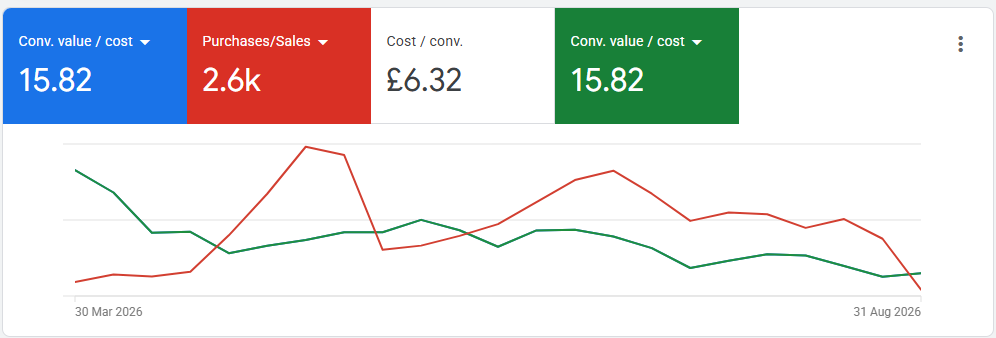
Anonymized apparel account dashboard supplied by Adzlance. The graph labels span 30 March to 31 August 2026; the screenshot alone does not establish the complete reporting settings.
Google defines conversion value per cost as reported conversion value divided by ad cost. A value of 15.82 is equivalent to 15.82 in reported conversion value for each 1 of ad spend, or approximately 15.82x reported ROAS, provided the account's values and attribution are set correctly. The dashboard uses pounds for cost per conversion; it does not display total ad spend, profit, refund rate or the exact currency of all reported values.
The figure demonstrates substantial reported purchase activity. It cannot tell us which campaigns, feed changes, bidding decisions or creative assets produced it. Nor does it show whether the sale count excludes duplicates, how returns were handled, or the contribution after product cost and fees. Those checks matter before using this result as a basis for another store's budget.
Is a High ROAS the Same as Profit?
No. ROAS compares attributed conversion value with advertising spend. Profit also depends on product cost, discounts, shipping, payment fees, returns, operations and any agency fee. A store can report an impressive ROAS yet make little money on low-margin orders.
Use a simple break-even calculation as a starting point. If a store retains 40% of revenue after variable costs before advertising, it needs about 2.5x ROAS merely to cover ad spend: 1 divided by 0.40. Its real target may need to be higher to fund overhead and profit. A product group with 20% contribution before advertising has a different threshold from one with 60%.
The example is arithmetic, not a recommended target for every apparel brand. Estimate contribution margins by product or category, account for first-order versus repeat-customer value, and agree on a target that fits cash flow. Watch absolute contribution as well as the ratio: a campaign can improve ROAS while total profitable sales fall.
How Should Purchase Tracking Be Checked?
Confirm that the primary purchase conversion fires once for a completed order, sends the amount the store intends to optimize toward, uses the correct currency, and handles refunds or cancellations in the business reporting. Compare a sample of order IDs and values against the ecommerce platform. If several purchase actions are set as primary, investigate possible duplication before bidding to a target ROAS.
Google's conversion value guidance explains why values affect optimization. An inaccurate value signal can shift spend toward the wrong products even when the purchase count looks plausible.
Attribution and platform reports can differ. Use Google Ads to improve campaign decisions while reconciling trends with store orders, margins and finance data. Our offline conversion tracking guide gives a broader explanation of why the first reported conversion is not always the whole commercial result.
How Can Apparel Brands Avoid Wasted Spend?
Apparel creates a few recurring problems: sizes sell out quickly, variants are difficult to maintain, returns can be high, and promotions change the margin on the same SKU. Audit those business details alongside the ad account.
- Exclude or deprioritize unavailable items. Keep feed stock status aligned with the store.
- Separate materially different margins. A discounted item should not inherit the same acquisition target as a full-price bestseller without review.
- Make product pages easy to buy from. Show size guidance, delivery costs, return terms and clear photographs before checkout.
- Review search and product performance. Find irrelevant queries, products with spend but few orders, and items with repeatable profitable demand.
- Check seasonal shifts. Rotate attention with stock and customer demand rather than leaving last season's hero product funded indefinitely.
Change one major variable at a time where practical. If the feed, budget, bid target and landing page all change together, it becomes harder to understand which change helped. A free Google Ads audit can identify feed, tracking and budget problems before a store commits more spend.
When Should a Store Increase Its Budget?
Scale when the store can fulfill additional orders and sees a reliable contribution after advertising. Look beyond one strong week. Check that conversion tracking is stable, the winning products have stock, customer service can handle demand, and the target remains viable when returns arrive.
Increase the budget in measured steps, then watch order volume, contribution margin, new-customer mix and fulfillment. If sales rise but gross profit does not, review which products absorbed the extra spend. If reported ROAS drops temporarily, inspect the underlying economics rather than reacting to one daily number.
The apparel screenshot shows what a strong account-level reported ratio can look like. It is a reason to inspect the inputs behind the figure, not a promise that another ecommerce store can reproduce it. Adzlance can help ecommerce brands improve their Google Ads management and purchase measurement around profitable product demand. If you are unsure what your account is measuring, start with a free Google Ads audit.
Frequently Asked Questions
Are Google Ads worth it for a small ecommerce store?
They can be if the store has products people search for, enough margin to acquire customers, a reliable feed, accurate purchase tracking and product pages that convert. Start with a focused inventory group and assess contribution after ad spend.
Should an apparel brand use Shopping or Performance Max?
Either may fit. Shopping offers a product-led advertising route; Performance Max can use the feed and assets across more Google inventory. Choose based on measurement quality, desired control and the store's ability to review product and campaign results.
What does 15.82 conversion value per cost mean?
It means Google Ads reported 15.82 units of conversion value per unit of ad cost for the displayed account view. It is roughly 15.82x reported ROAS, subject to correct values, attribution and reporting scope. It is not a profit margin.
Is £6.32 the cost of acquiring a new customer in the screenshot?
The screenshot labels £6.32 as cost per reported conversion. It does not show whether every conversion was a unique new customer, whether repeat purchases were included, or whether the conversion action was free of duplicates.
How long should an ecommerce brand test Google Ads?
Allow enough time to collect meaningful purchase data, review search and product performance, and account for the sales cycle. Set a test budget and evaluation criteria in advance; do not promise a universal number of days or guaranteed ROAS.
More practical Google Ads guides
Continue with practical guides to campaign planning, budgeting, and choosing the right campaign type.