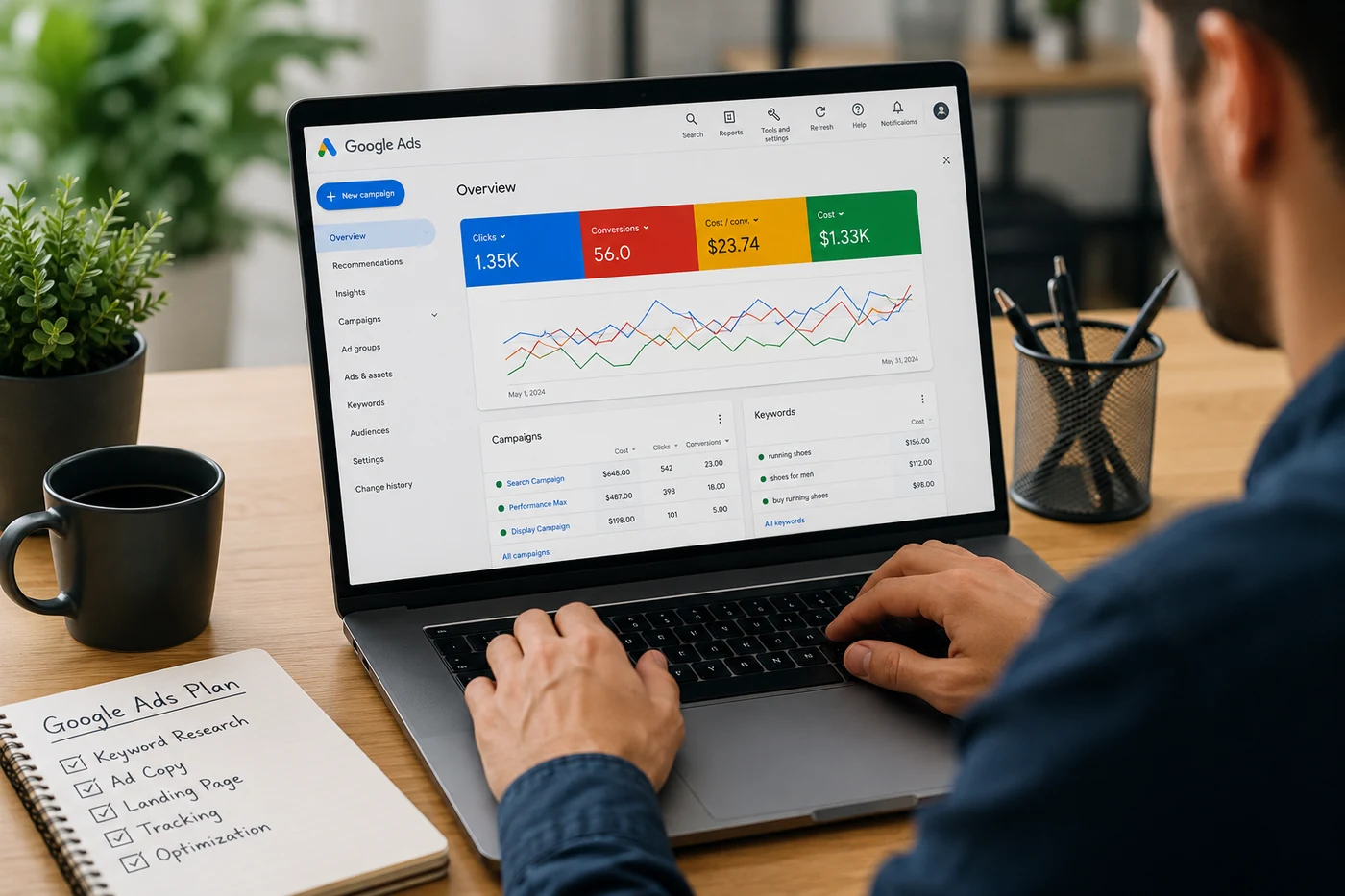

A free Google Ads audit for New York City businesses should reveal where expensive clicks are being wasted, whether the reported conversions represent real customers, and which corrections deserve attention first. Adzlance uses a structured 36-point Google Ads account review covering conversion tracking, search terms, campaign structure, bidding, budgets, locations, ads, landing pages, and supporting account settings.
In this guide
- What does Adzlance check during an NYC Google Ads audit
- What could be going wrong in an NYC account
- What will a New York City business receive
- Case study what reliable measurement can support
- How can Adzlance help after the audit
- When is a free NYC audit worth requesting
- Understand the account before increasing the budget
- Frequently asked questions
- About the author
If you are comparing a Google Ads agency in New York City, the audit should provide more than an automated health score. It should explain what is wrong, why it matters commercially, and what should happen next. Adzlance also provides Google Ads management in New York City when the account needs implementation and ongoing optimization.
Businesses considering PPC management services in NYC can use the findings before making a commitment. Read-only access is enough, so nothing is changed during the review. The written report is yours to keep and share with an in-house marketer or another provider.
What does Adzlance check during an NYC Google Ads audit
The 36 checks answer practical questions: Are expensive searches producing qualified enquiries? Is one borough consuming budget without returning customers? Are conversions measured correctly? What should be fixed before spending more?
1 Conversion tracking and customer quality
Google Ads uses conversion data to guide automated bidding. If the account counts weak or duplicated actions, the system can optimize toward activity that looks successful but does not create revenue.
The audit checks:
- Calls, forms, bookings, and purchases firing correctly
- Duplicate conversions across Google Ads, GA4, and Google Tag Manager
- Phone-number clicks being counted without a connected call
- Call-duration thresholds and whether recorded calls are connected, relevant enquiries
- Primary and secondary conversion actions
- Purchase values and transaction duplication
- Enhanced conversions, offline imports, attribution, and lookback windows
A tracking tag can be active and still provide poor business signals. The review compares its setup with the outcomes the company values.
2 Borough and service-area targeting
New York City should not automatically be treated as one audience. A practice may serve patients within a realistic travel distance. A contractor may cover selected neighborhoods or boroughs. A professional service may serve all five boroughs but find that customer value and conversion rates vary significantly.
The audit reviews:
- Manhattan, Brooklyn, Queens, the Bronx, and Staten Island coverage
- ZIP-code, radius, city, and borough targeting choices
- Presence settings versus broader location interest
- Clicks and leads originating outside the useful market
- Location exclusions and overlapping target areas
- Performance differences by borough, device, and campaign
- Expansion into Long Island, Westchester, or nearby New Jersey without a clear plan
Hotels, events, tourism, and relocation services may want people planning a visit. A clinic or home-service company usually needs tighter control. The audit checks targeting against the actual customer journey.
3 Search terms match types and negatives
Keywords are selected by the advertiser. Search terms are the queries people actually typed. In a competitive market, weak search-term control can turn small mismatches into substantial wasted spend.
The review looks for:
- Research, job, training, DIY, free, and low-intent searches
- Services or products the business does not provide
- Searches from outside the intended market
- Expensive terms producing no qualified outcome
- Broad match expanding into loosely related demand
- Negative-keyword gaps and conflicts
- Brand, competitor, and generic demand being mixed together
The Google Ads audit checklist explains why match types, locations, tracking, overlap, and landing pages deserve attention. The NYC audit applies them to the real account history.
4 Campaign structure and account settings
An account can keep spending while its structure hides the decisions that matter. Multiple services may compete for one budget, branded searches may be mixed with new-customer demand, or several campaigns may target the same queries.
The audit checks:
- Campaigns organized around real intent, offers, products, and locations
- Search and Performance Max overlap
- Brand, generic, competitor, and local demand being combined
- Search Partners, Display expansion, or overlapping campaigns consuming budget
- Schedules that do not match staff or appointment availability
- Devices and audiences using spend without useful outcomes
- Too many campaigns dividing a limited budget
Good structure reveals which offers, boroughs, searches, and landing pages create qualified business.
5 Bidding budgets and high-cost searches
Automated bidding needs reliable conversion data and achievable targets. It can struggle when a campaign is given an unproven target CPA, learns from low-value actions, or receives too little meaningful data.
The review examines:
- Whether the bid strategy matches conversion volume and business goals
- Target CPA or Target ROAS settings against account history
- Budget allocation between strong and weak campaigns
- Profitable campaigns being limited while weaker activity keeps spending
- Frequent target and budget changes interrupting learning
- Whether the account is optimizing toward customers or weaker actions
High CPC does not automatically make a keyword bad. An expensive click can be worthwhile when it produces a valuable customer.
6 Ads assets and landing pages
A relevant search can still become wasted spend when the ad promises one thing and the landing page delivers another. The audit reviews the complete path from query to enquiry.
That includes:
- Ad copy matching the service, product, borough, and search intent
- Responsive search ad coverage and unnecessary pinning
- Sitelinks, callouts, structured snippets, and phone assets
- Mobile usability, page speed, and calls to action
- Form length, booking friction, phone visibility, and trust signals
- Landing pages trying to cover too many services or locations
- Disapproved or limited ads reducing reach
Recommendations are prioritized by commercial impact rather than visual preference.
7 Performance Max Shopping audiences and recommendations
For Performance Max and Shopping, Adzlance checks campaign overlap, listing groups, product-feed issues, brand exclusions, asset groups, search themes, and whether branded demand makes performance appear stronger than it is.
The review can also cover remarketing, Customer Match, audience settings, and first-party data. Automated recommendations are checked against lead quality, margins, budget, and campaign purpose.
What could be going wrong in an NYC account
Most wasted spend comes from several smaller problems working together.
| Possible issue | What Google Ads may report | What the business experiences |
|---|---|---|
| Duplicate or weak conversion tracking | More conversions and a lower CPA | Fewer qualified customers than the dashboard suggests |
| Broad geographic targeting | Reach across NYC and nearby markets | Enquiries from areas the business cannot serve profitably |
| Weak search-term control | Healthy traffic and impression volume | Calls for unrelated services or low-intent enquiries |
| Wrong bidding goal | Campaign appears to reach its target | Automation favors actions that rarely become customers |
| Boroughs combined without analysis | Acceptable citywide averages | Strong areas subsidize locations producing weak leads |
| Poor landing-page match | Clicks continue arriving | Visitors leave without booking, calling, or purchasing |
| Slow response to leads | Google records a conversion | A faster competitor wins the customer |
The report separates urgent corrections from later tests, so the business does not change everything at once without learning what helped.
What will a New York City business receive
Adzlance returns written findings in priority order. Each finding explains:
- What was found
- Why it matters commercially
- What should be changed
- How urgent the correction is
The audit is reviewed personally rather than generated by a scanner. Findings are normally returned within two to four business hours after access is granted. Accounts spending over $50,000 per month or operating across several markets may take up to one business day.
The report may show that tracking needs repair, the budget is divided too widely, or the landing page needs attention. A useful audit does not automatically recommend spending more.
Case study what reliable measurement can support
One verified Adzlance healthcare example shows a dental practice achieving a $52 cost per lead across 224 conversions and 234 tracked phone calls. Supporting account evidence appears on the Adzlance results and case studies page.
This is not a promise that an NYC dental practice or another local business will achieve the same cost per lead. Results depend on competition, customer value, services, location coverage, budget, website experience, follow-up, and the account's starting condition.
Conversion and call measurement must be reliable. For longer sales cycles, offline conversion tracking can distinguish a form submission from a qualified opportunity or customer.
How can Adzlance help after the audit
The findings provide a starting point. The next step depends on the review.
Fix the priorities internally
An internal marketer or existing agency can use the report. Measurement problems and obvious waste should normally be corrected before major budget, bidding, or structural changes.
Ask Adzlance to implement the changes
Adzlance can repair tracking, restructure campaigns, clean search terms, improve negatives, revise ads, align landing pages, and manage ongoing optimization. Scope and fees depend on the advertising budget, account complexity, markets, campaign types, and tracking requirements. There is no fixed price for every account.
Delay expansion until the foundation is ready
Sometimes the correct decision is not to scale yet. The offer, website, call handling, appointment availability, tracking, or sales process may need improvement before more traffic is purchased.
When is a free NYC audit worth requesting
An audit is particularly useful when:
- Spend is rising but qualified leads or sales are not improving
- Reported conversions do not match CRM or business records
- Cost per qualified lead has increased
- The entire city is targeted without borough-level decisions
- Performance Max results are difficult to explain
- Reports focus on traffic instead of customer outcomes
- The business plans to increase its budget
- Search terms, negatives, or conversion goals have not been reviewed recently
- The business is changing agencies or bringing management in-house
An audit can also show which parts of the existing account are worth keeping. Not every campaign needs to be rebuilt.
Understand the account before increasing the budget
You should not need to raise the budget to discover that the account is measuring weak actions, targeting unsuitable locations, or paying for searches that cannot become customers.
Request a free Google Ads audit from Adzlance for a personal 36-point review of tracking, structure, search terms, bidding, budgets, New York City targeting, ads, landing pages, and supporting settings. The findings are written, prioritized, and yours to keep.
Frequently asked questions
Is the New York City Google Ads audit really free
Yes. The audit is free and carries no obligation. You receive the written findings whether or not you choose management.
Will anything be changed in my account
No. Read-only access is enough. Campaigns, budgets, ads, keywords, and conversion settings are not changed during the review.
How long does the audit take
Findings normally arrive within two to four business hours after read-only access is granted. Larger or multi-market accounts may require one business day.
Should an NYC business target all five boroughs
Only when the business can serve them profitably. The audit compares location coverage with lead quality, customer value, travel or delivery limits, and available budget.
Can the audit review an account with limited data
Yes, although limited history restricts conclusions. The review can still identify setup, tracking, targeting, structure, and landing-page risks.
Do I have to hire Adzlance afterward
No. You can implement the findings yourself, share them with another provider, or ask Adzlance to help. The report is yours to keep.
About the author
Gurdeep Singh is the founder of Adzlance and has more than five years of paid-media experience. He specializes in Google Ads, conversion tracking, campaign audits, and performance-focused advertising.
More practical Google Ads guides
Continue with practical guides to campaign planning, budgeting, and choosing the right campaign type.