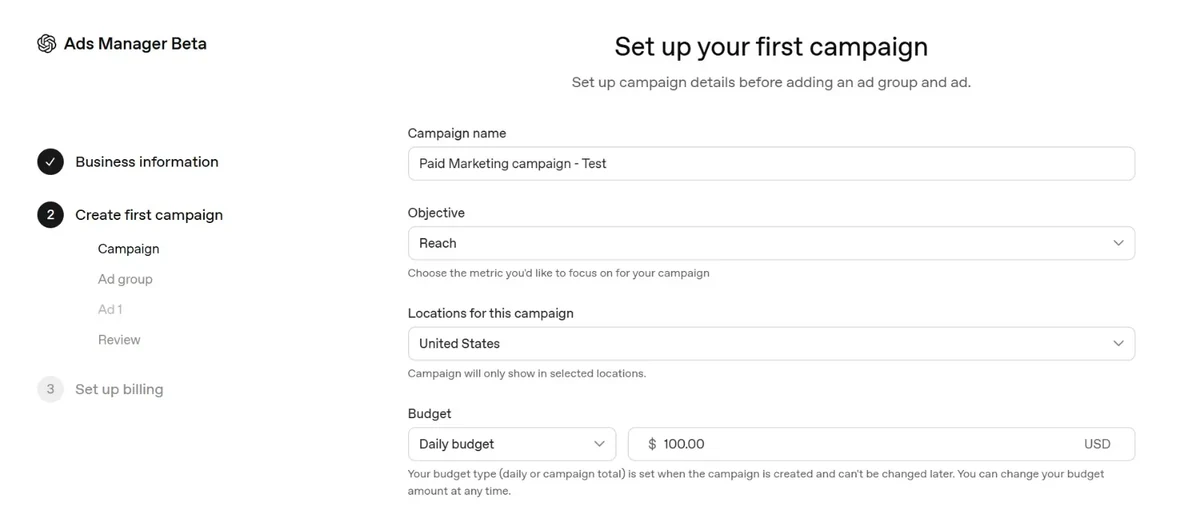

ChatGPT Ads targeting works differently from traditional search and social advertising. Instead of relying mainly on exact-match keywords or detailed interest profiles, the system evaluates the current conversation, the advertiser's landing page and creative, campaign controls, and optional context hints to decide whether an ad is relevant. For a broader overview of the platform, read our complete guide to ChatGPT Ads.
In practical terms, an advertiser gives OpenAI useful signals about the product, the people it helps, and the situations in which it may be relevant. OpenAI then combines those signals with campaign settings and auction factors. The advertiser does not choose a private conversation to enter, and cannot read a user's chats.
What Signals Decide Which ChatGPT Ad Appears?
OpenAI says ad selection can consider the context and intent of the current conversation, the ad's title and copy, the landing page, advertiser-provided context hints, and the campaign bid. When ad personalization is enabled by the user, the system may also consider selected signals from the person's broader ChatGPT experience.
That makes relevance a combination of several inputs rather than one targeting switch. OpenAI describes the auction as a relevance-weighted second-price auction, so both the bid and predicted relevance influence which eligible ad wins. Campaign structure, landing-page clarity, creative, and context hints therefore need to tell the same story.
What Are Context Hints in ChatGPT Ads?
Context hints are natural-language descriptions added at the ad-group level. They explain what the product or service is, who it helps, and the situations or conversations in which the ad may be useful.
A helpful context hint sounds like this:
Small-business owners comparing invoicing tools or looking for a faster way to create, send, and track professional invoices.
A weak version would be a disconnected list such as:
invoices, software, finance, business, automation, cheap.
The first example gives the system a clear need, audience, and use case. The second provides words without meaningful context.
OpenAI is explicit that context hints are not exact-match rules. They do not command the platform to show an ad whenever a particular phrase appears, and they do not guarantee delivery.
Are Context Hints the Same as Keywords or Audiences?
No. Context hints can contain important topics and phrases, but they are interpreted semantically rather than matched like a traditional search keyword list.
| Control | What it does | What it does not do |
|---|---|---|
| Context hint | Describes relevant needs, situations, topics, and users in natural language | Guarantee placement for an exact word or phrase |
| Search keyword | Enters an ad into eligible searches based on keyword and match-type logic | Describe a full conversational need by itself |
| Custom audience | Includes, excludes, or adjusts bids for matched first-party users | Reveal a user's ChatGPT conversations to the advertiser |
This distinction matters when comparing ChatGPT Ads with Google Ads and Meta Ads. Google Search often begins with a typed query, while ChatGPT Ads can combine conversational relevance with campaign controls and first-party audience options.
How Should Advertisers Write Effective Context Hints?
Start with the customer's situation, not an internal product label. A person may not use the same language that appears in your sales deck, but they will usually describe the problem they are trying to solve.
Keep each ad group focused on one theme
If a software company serves freelancers, agencies, and large finance teams, those needs should not automatically sit in one broad ad group. Separate themes make it easier to align each hint, ad, and landing page.
Describe the need and useful moment
A good hint explains what the user is trying to do, the problem they face, who the product helps, and when the offer becomes useful. For example, an HVAC company could describe homeowners whose air conditioner has stopped cooling or who are comparing repair and replacement options in a supported area.
Use natural language
Write complete, understandable phrases. Avoid stuffing synonyms, competitor names, or every possible variation into one field. Context hints work best when they clarify relevance rather than trying to manipulate it.
Align the landing page and creative
If the hint describes emergency HVAC repair but the ad promotes a generic home-services homepage, the experience is weak. The creative should state the relevant offer, while the landing page should immediately confirm the service, location, value, and next step.
Our ChatGPT Ads campaign setup guide explains how these ad-group decisions fit into the wider campaign-building process.
What Campaign-Level Targeting Controls Are Available?
Context hints are only one layer. OpenAI also provides campaign controls that determine where and to whom a campaign may be eligible to deliver.
Location targeting
Campaigns can target countries. In the United States, OpenAI documentation also lists supported states or regions, cities, designated market areas, and ZIP codes where available. Advertisers should use the narrowest geography that matches their actual service area without making the audience too restrictive.
Platform targeting
Advertisers can select iOS, Android, and Web, including desktop and mobile web. Platform selection should reflect the landing-page experience and conversion path. A page that is difficult to complete on a phone may waste mobile traffic even when the ad itself is relevant.
Custom audiences
OpenAI supports customer and prospect lists built from identifiers such as email addresses, phone numbers, hashed identifiers, and mobile advertising IDs. Campaigns can include or exclude those audiences, while ad groups can use bid adjustments for matched users.
This is an important platform development. Older descriptions of ChatGPT Ads as having no audience controls are now incomplete. Advertisers still should not treat the platform like a copy of Meta, but first-party audience tools are part of the current setup.
How Do Custom Audience Bid Adjustments Work?
Custom audiences can help an advertiser distinguish between existing customers, qualified prospects, and people who should be excluded from acquisition activity. An ad group might raise its bid for a matched high-value prospect list or reduce spend on current customers when the offer is intended only for new buyers.
OpenAI currently states that audience inclusion and bid adjustments require at least 25,000 matched users, and recommends uploading a list with 100,000 or more records to improve the chance of reaching that threshold. Smaller matched audiences can still be used for exclusion.
Those thresholds favor brands with meaningful first-party data. Smaller advertisers can still build relevant campaigns through clear context hints, locations, platforms, creative, and landing pages.
Does Personalization Affect ChatGPT Ad Targeting?
Yes, but the distinction is important. OpenAI says the current conversation can be used to select a contextually relevant ad even when ad personalization is turned off. If personalization is enabled, the system may also use selected signals from the user's broader ChatGPT experience.
Advertisers do not receive the conversation. OpenAI says it does not share chats, history, memories, or personal details with advertisers. Advertisers receive aggregated, non-identifying performance information rather than access to what an individual user wrote.
That privacy boundary should shape how marketers discuss the channel. It is accurate to say an ad may be selected because it is relevant to the current conversation. It is not accurate to say an advertiser can read or target a person's private chat.
What Does a Good ChatGPT Ads Campaign Structure Look Like?
Imagine a project-management platform serving two distinct groups. A clear structure could look like this:
- Campaign: United States, Web and mobile apps, qualified prospect audience included where large enough.
- Ad group one: Freelancers planning client work, deadlines, and invoices.
- Ad group two: Small agencies coordinating team workloads, approvals, and client reporting.
- Creative: A separate message for each use case rather than one generic productivity claim.
- Landing pages: Each ad leads to the page that best matches its audience and promise.
This structure creates consistent signals and cleaner performance data. Budgets and bids can then be adjusted by use case.
What Targeting Mistakes Should Advertisers Avoid?
The most common mistakes are usually clarity problems rather than missing tricks.
- Writing context hints like keyword dumps. Disconnected terms provide less meaning than a clear need and use case.
- Combining unrelated products. One ad group should not try to serve every offer and audience.
- Using vague creative. Generic claims such as “transform your business” do not explain why the offer fits the conversation.
- Sending traffic to a generic homepage. A relevant ad can still fail when the landing page does not continue the message.
- Targeting locations the business cannot serve. More reach is not better when leads are unusable.
- Over-restricting the campaign. Too many narrow settings may reduce delivery before the platform gathers useful data.
- Ignoring first-party exclusions. Eligible advertisers may pay to reacquire customers who already completed the desired action.
How Should You Measure Targeting Quality?
Do not judge targeting only by impressions or click-through rate. A campaign can attract curiosity without producing valuable outcomes.
Review delivery, clicks, cost, conversions, conversion rate, cost per conversion, and the quality of leads or sales. Compare performance by ad group, creative, location, platform, and audience treatment where reporting permits. Before scaling, confirm that conversion tracking represents a meaningful business action rather than a low-value page event.
Isolate major changes when possible. Rewriting context hints, replacing the landing page, and changing bids on the same day makes it difficult to understand what improved performance.
Advertisers planning spend should also review how much ChatGPT Ads cost because bid strategy and budget influence how often an eligible, relevant ad can compete.
What Should You Check Before Launching?
- Separate major products, audiences, or use cases into focused ad groups.
- Write natural context hints describing a genuine need and useful moment.
- Match the ad copy and landing page to each ad group's theme.
- Select only locations and platforms the business can support.
- Include or exclude first-party audiences when the list size and objective justify it.
- Verify conversion tracking before paying for traffic.
- Review lead quality, not just clicks, after launch.
ChatGPT Ads targeting is less about finding a secret phrase and more about building a coherent relevance system. When the context hint, creative, landing page, campaign controls, bid, and measurement plan all support the same customer need, the platform has a stronger basis for delivery and the advertiser has a clearer basis for optimization.
For the commercial decision behind the campaign, see our guide to the small-business ChatGPT Ads testing decision.
Want help building a focused ChatGPT Ads campaign?
Adzlance can help translate your offer into focused ad groups, context hints, landing-page alignment, tracking, testing, and ongoing optimization.
Explore ChatGPT Ads management →Frequently Asked Questions
Are ChatGPT Ads context hints the same as keywords?
No. Context hints are natural-language descriptions of relevant needs, users, and situations. They can include important topics, but OpenAI does not treat them as exact-match keyword commands or guarantee delivery for a phrase.
Can advertisers see users' ChatGPT conversations?
No. OpenAI says advertisers do not receive chats, conversation history, memories, or personal details. They receive aggregated, non-identifying campaign performance information.
Can ChatGPT Ads target specific locations?
Yes. Campaigns can target countries, and supported US campaigns may also use states or regions, cities, designated market areas, and ZIP codes where available.
Can advertisers target iOS, Android, and Web separately?
Yes. OpenAI lists iOS, Android, and Web as platform targeting options. Advertisers should ensure the landing page and conversion journey work properly on every selected platform.
Can ChatGPT Ads use customer lists?
Yes. OpenAI supports custom audiences using identifiers such as email, phone, hashed IDs, and mobile advertising IDs. These audiences can support inclusion, exclusion, and certain bid adjustments, subject to matching thresholds.
Do context hints guarantee that an ad will appear?
No. Context hints improve the system's understanding of relevance, but delivery also depends on campaign eligibility, the auction, bid, predicted relevance, creative, landing page, and available opportunities.
Is ChatGPT Ads targeting suitable for small businesses?
It can be, especially when the business has a clear offer, defined service area, relevant landing page, and reliable conversion tracking. Small businesses may not meet custom-audience thresholds, but they can still use context hints, location settings, platform controls, and focused creative.
About the author
Gurdeep Singh is the founder of Adzlance, a paid media agency specializing in Google Ads, Meta Ads, ChatGPT Ads, conversion tracking and performance-focused advertising.
Platform information reviewed against official OpenAI documentation on 1 September 2026. ChatGPT Ads features and thresholds may change as the platform develops.
More About ChatGPT Ads
Continue with practical guides for planning, launching and budgeting your campaigns.