
ChatGPT Ads can be worth testing for a small business, but the value comes from relevance, not novelty. The strongest opportunity is reaching someone while they are actively exploring a problem, comparing options, or deciding what to do next. A small test can reveal whether those conversations lead to qualified website visits, enquiries, or sales. Adzlance provides ChatGPT Ads management for businesses that want the campaign, tracking, and reporting set up properly from the start.
The important word is testing. ChatGPT Ads Manager is still a beta product, and OpenAI says its capabilities will continue to evolve. That makes this a channel to evaluate with a defined budget and a clear success measure, not a place to assume predictable results before the data exists.
Why Are Small Businesses Paying Attention to ChatGPT Ads?
People often use ChatGPT differently from a traditional search box. Instead of typing two or three words, they may explain their situation, ask follow-up questions, compare choices, and refine what they need. An ad can appear below the response when OpenAI's system considers it relevant to that conversation.
That creates an interesting moment for advertisers. The user may already be thinking through a decision, but the business does not need to interrupt the answer or compete for attention in a busy social feed. The ad sits separately below the response as a sponsored placement.
OpenAI says delivery considers the current conversation, the landing page, the ad title and copy, advertiser-provided context hints, and selected personalization signals when the user has enabled ad personalization. Context hints guide matching, but they are not exact-match keywords and do not guarantee that an ad will appear in a specific conversation.
Our guide to how ChatGPT Ads targeting works explains this matching system in more detail.
So, Are ChatGPT Ads Actually Worth It?
They are worth a controlled test when the campaign can answer a real commercial question. For example: can ChatGPT send visitors who understand the offer, spend time on the landing page, and complete a meaningful action at an acceptable cost?
That is a better question than asking whether the platform is “good” in general. A new advertising channel can produce valuable leads for one offer and weak traffic for another. The result depends on the conversation fit, the clarity of the message, the landing page, the bid, and the quality of conversion measurement.
The platform currently supports three campaign objectives:
| Objective | How you pay | What delivery prioritizes |
|---|---|---|
| Reach (CPM) | Per 1,000 impressions | Visibility and exposure |
| Clicks (CPC) | Per valid click | Website visits and engagement |
| Conversions (oCPC) | Per valid click | Clicks more likely to produce a selected conversion |
For a small business, CPC or conversion-optimized CPC usually creates a clearer test than paying only for reach. You still need to judge what happens after the click. A low CPC is not valuable when the visitors never enquire or buy.
What Makes the Placement Different?
ChatGPT Ads appear below responses and include the advertiser name, favicon, headline, description, landing page, and image creative. OpenAI states that ads are separate from answers and do not influence what ChatGPT says.
The placement is also limited to part of the ChatGPT audience. Ads may appear for users on Free and Go plans. OpenAI does not show ads to Plus, Pro, Business, Enterprise, or Edu accounts, or to accounts identified as belonging to users under 18. Temporary Chats do not show ads either. These limits matter because the potential reach is not the same as ChatGPT's total user base.
For advertisers, the main advantage is contextual timing. A useful ad can connect the conversation to a next step without pretending to be part of the answer. The main challenge is that generic messaging will struggle to feel relevant when the user has described a specific need.
How Much Does a Small ChatGPT Ads Test Cost?
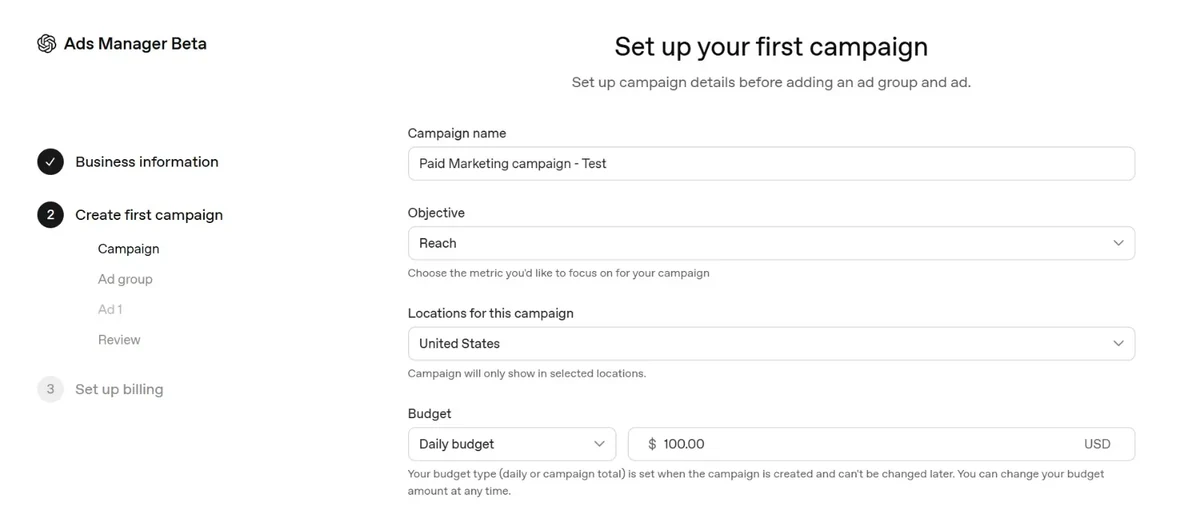
For campaigns billed in US dollars, OpenAI currently lists a $25 minimum daily budget. That is a platform minimum, not a complete testing recommendation.
At $25 per day, a 30-day campaign represents approximately $750 in available media spend. A business may choose a larger budget when it needs more clicks or conversions to make a useful decision. The right amount depends on the bid, expected conversion rate, value of the outcome, and length of the sales cycle.
OpenAI recommends beginning CPC campaigns with a maximum bid of $3 to $5 per click. That range is guidance, not a fixed price. Ads are selected through a relevance-weighted, second-price auction, and Ads Manager may show whether a bid is likely to be competitive or restrict delivery.
The campaign can use either a daily budget or a campaign-total budget. OpenAI notes that daily spend may fluctuate: spending will not exceed twice the chosen daily budget on an individual day, and it will not exceed seven times the daily budget over the applicable seven-day period.
For a detailed calculation, see how much ChatGPT Ads cost.
What Should the First Campaign Try to Learn?
A first campaign should have one primary job. Trying to test every product, location, message, and customer group at once makes the result difficult to interpret.
Choose one offer and one conversion action. Then write context hints around the situations in which that offer is genuinely useful. A bookkeeping firm, for example, should not use a broad hint such as “small business.” It could describe conversations about cleaning up overdue books, preparing financial records, or choosing support before tax season, provided those services are actually offered.
Create more than one ad variation. Test a practical benefit, a proof point, and a direct next step rather than changing only one adjective. Keep the landing page consistent with the promise in the ad.
OpenAI supports campaign-level country targeting and, in the United States, supported state, DMA, and ZIP-code targeting. Platform targeting can include iOS, Android, and web. Use only the locations and surfaces the business can serve reliably.
The ChatGPT Ads campaign setup guide covers the full build process.
How Should You Measure Whether the Test Worked?
Ads Manager currently reports impressions, clicks, spend, click-through rate, average CPC, average CPM, and conversions. Those metrics describe campaign activity, but a small business still needs its own definition of success.
For lead generation, record whether enquiries were genuine, contactable, relevant, and commercially valuable. For e-commerce, compare revenue and gross profit with media spend rather than celebrating clicks or add-to-cart events alone. Where the sales cycle is longer, connect the original click to later qualified outcomes whenever the tracking setup permits it.
Use conversion measurement in Ads Manager and add consistent UTM parameters to landing-page URLs. OpenAI says static tracking parameters persist on ad clicks, allowing traffic to be analysed in existing analytics tools.
Before launch, confirm that:
- The primary conversion fires once and only after the intended action.
- The landing page keeps the promise made by the ad.
- Phone calls and forms are classified consistently.
- Internal or test submissions are excluded from decision-making.
- Reporting distinguishes traffic activity from qualified business outcomes.
If the tracking is not trusted, the campaign cannot give a trustworthy answer.
What Can Make a ChatGPT Ads Test Misleading?
Treating context hints like keywords
Context hints describe relevant conversations. They do not force an exact match, and they do not guarantee placement. Write them as clear customer situations rather than disconnected keyword lists.
Using one generic advertisement
A vague headline such as “Quality solutions for your business” gives the user little reason to act. The message should connect the conversation to a concrete benefit, offer, or next step.
Sending every click to the homepage
The landing page is one of the signals OpenAI considers during delivery. It also determines whether the user understands the offer after clicking. A focused service or product page is usually more useful than a broad homepage.
Optimizing for the easiest action
If the selected conversion is a weak engagement event, the system can pursue activity that looks efficient without creating customers. Use the most meaningful action that can be tracked accurately.
Changing the campaign too quickly
A few clicks rarely prove that a channel works or fails. Set a review point based on an affordable amount of evidence, while fixing clear technical problems immediately.
A Practical Small-Business Testing Plan
- Define the decision. State exactly what the campaign must demonstrate to justify further investment.
- Choose one offer. Keep the first test focused enough that the result is understandable.
- Verify tracking. Test the conversion event, analytics, and UTM capture before spending.
- Build context-based ad groups. Separate materially different customer situations instead of mixing them together.
- Create useful variations. Give each version a distinct message, not cosmetic wording changes.
- Set a protected budget. Use an amount the business can afford to treat as learning, with a clear stop or review point.
- Review quality, not just volume. Judge enquiries, purchases, revenue, and profit alongside Ads Manager metrics.
This approach keeps the first campaign commercially useful even if the result is “not yet.” A disciplined test should produce evidence, not simply spend the budget.
The Bottom Line
ChatGPT Ads are worth considering because they can reach people during detailed, decision-oriented conversations. They are not automatically worth the spend simply because the platform is new or receives attention.
The sensible approach is a measured campaign with one clear offer, accurate conversion tracking, strong context hints, and reporting tied to real outcomes. OpenAI Ads Manager remains in beta, so every recommendation should be checked again immediately before launch.
If you want a direct assessment before committing budget, talk to Adzlance about managing a ChatGPT Ads test. The goal is to determine whether the opportunity is commercially sound for your offer, not to sell the novelty of the platform.
Frequently Asked Questions
Does ChatGPT have ads for small businesses?
Yes. Eligible advertisers can create and manage campaigns through OpenAI Ads Manager Beta, subject to current country availability, account verification, billing, and policy requirements.
What is the minimum budget for ChatGPT Ads?
OpenAI currently lists a $25 minimum daily budget for campaigns billed in US dollars. Minimums vary by billing currency and may change as the beta develops.
Can ChatGPT Ads generate leads?
They can send visitors to a landing page and optimize toward tracked conversion events. Whether those visitors become qualified leads depends on targeting relevance, the offer, the page, follow-up, and measurement quality.
How are ChatGPT Ads targeted?
Delivery considers conversational context, landing-page relevance, ad content, context hints, geography, platform settings, and permitted personalization signals. Context hints guide matching but are not exact-match keywords.
Can I track ChatGPT Ads conversions?
Yes. Ads Manager supports conversion measurement, and advertisers can add UTM parameters to landing-page URLs for analysis in their existing analytics tools.
Where do ChatGPT Ads appear?
Ads appear below ChatGPT responses as clearly labelled sponsored placements. They are separate from the answer and do not influence it.
Are ChatGPT Ads guaranteed to work for a small business?
No. No advertising platform guarantees profitable results. A controlled test with accurate tracking is the responsible way to evaluate performance for a specific offer.
About the author
Gurdeep Singh is the founder of Adzlance, a paid media agency specializing in Google Ads, Meta Ads, ChatGPT Ads, conversion tracking and performance-focused advertising.
Platform information reviewed against official OpenAI documentation on 5 September 2026. ChatGPT Ads features, eligibility and pricing may change as the beta develops.
More About ChatGPT Ads
Continue with practical guides for understanding targeting, cost and campaign setup.