
Adzlance helps advertisers choose between ChatGPT Ads Views, Clicks and Conversions by starting with the business outcome, not the cheapest-looking billing model. Views is designed for exposure, Clicks for qualified website traffic, and Conversions for actions such as leads or purchases. The best choice depends on your goal, tracking readiness, available conversion data and budget. If you want expert help planning the campaign, review our ChatGPT Ads management services.
In this guide
- ChatGPT Ads objectives at a glance
- What does the Views objective do in ChatGPT Ads?
- Which ChatGPT Ads objective is best for a new campaign?
- Can I change the ChatGPT Ads campaign objective after launching?
- Which objective should you use with a limited budget?
- Views vs Clicks: awareness or active interest?
- Clicks vs Conversions: traffic or business outcomes?
- How do oCPC and oCPM differ for conversion campaigns?
- How should you evaluate whether the objective is working?
- A simple decision framework
- Final Thoughts
- Frequently Asked Questions
- About the author
ChatGPT Ads objectives at a glance
| Objective | Optimizes for | Typical billing | Best fit | Main caution |
|---|---|---|---|---|
| Views | Visibility and exposure | CPM | Awareness, launches and reach | Impressions do not prove interest |
| Clicks | Valid visits to a website or product page | CPC | Traffic, research and early testing | A click is not automatically a qualified lead |
| Conversions | A supported tracked event | oCPC or oCPM for eligible advertisers | Leads, signups and purchases | Needs reliable tracking and a clear event goal |
OpenAI currently describes Views as a CPM objective, Clicks as a CPC objective, and Conversions as an optimization option for supported conversion events. Eligible conversion advertisers may be able to choose click billing, called oCPC, or impression billing, called oCPM. A Conversions campaign is not billed only when a conversion happens.
What does the Views objective do in ChatGPT Ads?
The Views objective is built to maximize visibility and exposure. Advertisers pay per 1,000 impressions, so it is most useful when the immediate goal is to place a message in front of relevant people rather than drive a specific website action. It can support a product launch, a new category, a broad awareness campaign or a message that needs repeated exposure.
Views does not mean that clicks or conversions are impossible. It means the system is not primarily selecting opportunities based on the likelihood of those later actions. Judge it with impression delivery, CPM, reach indicators where available, creative response and downstream assisted behavior. Do not call it successful only because the CPM is low. Cheap exposure to the wrong audience has little business value.
Which ChatGPT Ads objective is best for a new campaign?
For many new advertisers, Clicks is the clearest starting point because it produces website visits that can reveal whether the offer, audience context and landing page are working together. It is especially practical when conversion tracking is new or the business does not yet generate enough reliable events for optimization. However, it is not a universal default.
Choose Views first when the actual goal is awareness. Choose Conversions from the beginning when the Pixel or Conversions API is verified, the selected standard event reflects real business value, and the campaign can generate enough clean signals to guide optimization. OpenAI says conversion optimization requires conversion tracking, a supported standard event and a clear event goal. Custom events are not currently supported for optimization.
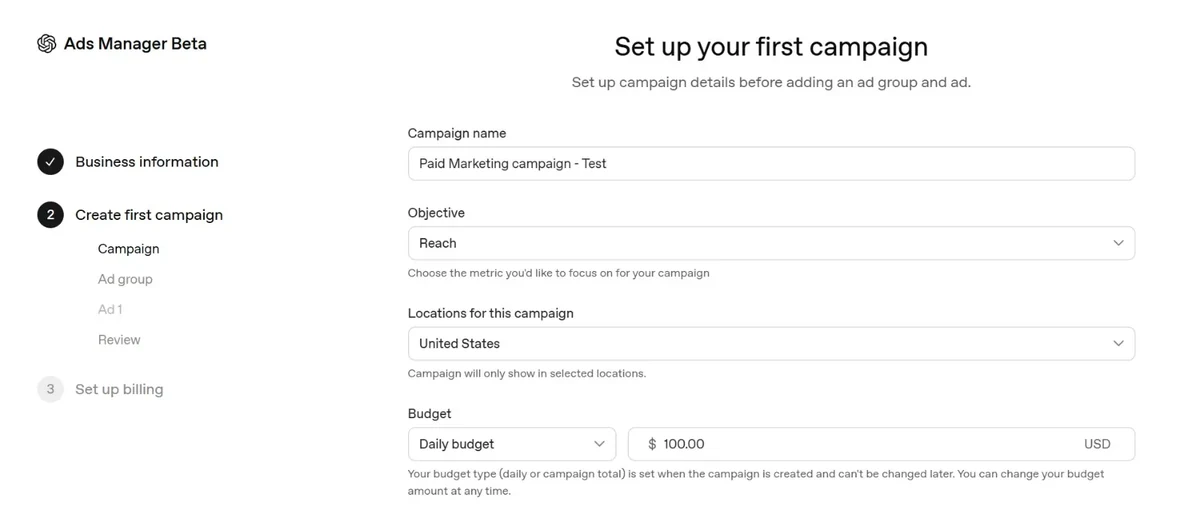
Before launch, follow the ChatGPT Ads campaign setup guide and test the full journey from ad to landing page to the final action. A technically available objective is not necessarily the right objective if the measurement foundation is incomplete.
Can I change the ChatGPT Ads campaign objective after launching?
No. OpenAI states that the campaign objective and billing choice cannot be changed in place after launch. To move from Views to Clicks, from Clicks to Conversions, or between eligible conversion billing choices, create a new campaign with the new settings, or use a supported cloning option where available.
This limitation makes prelaunch planning important. Before publishing, confirm the business outcome, conversion event, billing model, landing page and measurement method. If the first objective was wrong, preserve the original campaign for reporting, create the replacement, and document the date of the change. That prevents two different optimization strategies from being treated as one continuous test.
Which objective should you use with a limited budget?
With a limited budget, use one focused objective tied to the nearest meaningful outcome you can measure reliably. Do not divide a small budget across Views, Clicks and Conversions at the same time. Fragmentation reduces the number of useful observations each campaign can collect and makes the results harder to interpret.
Clicks is often sensible for a new, limited-budget test because spend is tied to valid visits and the advertiser can assess audience fit, landing page engagement and lead quality. Conversions can be the better option when tracking is already dependable and the event occurs often enough to guide optimization. Views should be selected only when awareness is genuinely the goal, not simply because CPM appears cheaper than CPC.
Set a test budget that can produce enough activity to evaluate the campaign. The practical range will vary by audience, bid, objective and market. Our ChatGPT Ads cost guide explains billing and budget factors without treating a single spend level as a guarantee.
Views vs Clicks: awareness or active interest?
Views answers the question, “How efficiently can we expose the message?” Clicks answers, “How efficiently can we earn a valid visit?” That difference should shape both the creative and the landing experience.
Use Views when remembering the brand or understanding a new offer is valuable even if the user does not leave ChatGPT. Use Clicks when the user must compare plans, inspect inventory, request a quote or read a detailed page. A useful diagnostic is to ask whether the campaign would still create value if nobody clicked today. If yes, Views may fit. If no, Clicks or Conversions is more aligned.
Clicks vs Conversions: traffic or business outcomes?
Clicks can generate fast directional learning, but the system is looking for people likely to click, not necessarily people likely to become customers. A high click volume can therefore hide weak lead quality, a confusing form, a slow checkout or an offer that does not match the message.
Conversions asks the system to optimize toward a supported event such as a lead or purchase. This is closer to business value, but only when the event is implemented correctly. If duplicate events, missing values or low-quality form fills are sent as success signals, the campaign may learn from the wrong behavior.
Verify the event before using it for optimization. Our ChatGPT Ads conversion tracking guide covers the Pixel, Conversions API, event testing and lead measurement.
How do oCPC and oCPM differ for conversion campaigns?
Eligible advertisers may see two conversion billing choices. With oCPC, billing is based on clicks and optimization focuses on conversions that follow clicks. With oCPM, billing is based on impressions and optimization can account for broader eligible conversion behavior influenced by views and clicks. Availability can depend on the account and Ads Manager experience.
Choose the model based on how customers normally respond. oCPC is easier to connect with direct visits and immediate actions. oCPM may suit campaigns where exposure contributes to the result even when the person does not click immediately. Neither option removes the need for trustworthy attribution and quality checks.
How should you evaluate whether the objective is working?
Use a primary metric that matches the objective, then add quality and business metrics. Views should be evaluated with delivery and meaningful downstream response. Clicks needs CPC and click-through rate, but also engaged visits, qualified leads and landing page behavior. Conversions needs conversion volume, conversion rate, cost per qualified action and revenue or pipeline value where applicable.
Our guide to ChatGPT Ads campaign metrics explains how to separate platform activity from business performance. A campaign should not be declared successful because one surface metric improved while lead quality or revenue declined.
A simple decision framework
- Write one measurable campaign goal. Use awareness, qualified visits, leads or purchases, not a mixture of all four.
- Confirm whether the necessary tracking event is working and represents real value.
- Choose Views for exposure, Clicks for website traffic, or Conversions for a supported action.
- Match the creative and landing page to that objective.
- Set one primary success metric and two quality checks before launch.
- Run the test long enough to collect useful evidence, then create a new campaign if the objective needs to change.
This framework keeps the decision grounded in the customer journey. It also gives the team a fair way to compare results without changing the definition of success after seeing the data.
Final Thoughts
At Adzlance, we recommend choosing the ChatGPT Ads objective that matches the result your business needs and can measure accurately. Views is for exposure, Clicks is for traffic, and Conversions is for supported tracked actions. New advertisers with limited data often learn more cleanly from a focused Clicks test. Businesses with verified tracking and dependable event signals can move closer to leads or revenue with Conversions. Awareness campaigns should use Views intentionally, not as a shortcut to cheaper-looking traffic.
Frequently Asked Questions
Are ChatGPT Ads Views the same as video views?
No. The Views objective refers to ad visibility and exposure billed on a CPM basis. It should not be interpreted as a video completion metric unless a specific reporting field says so.
Do Clicks campaigns optimize for leads?
Clicks campaigns optimize for valid clicks. They may generate leads, but the system is not primarily optimizing toward the lead event. Use Conversions when supported tracking and sufficient signal quality are available.
Are Conversions campaigns billed per conversion?
No. Eligible conversion campaigns may use optimized click billing or optimized impression billing. The objective optimizes toward a conversion event, but billing is not limited to completed conversions.
Can custom events be used for ChatGPT Ads conversion optimization?
OpenAI currently says custom events are not supported for conversion optimization. Select a supported standard event and verify it before launch.
Should an ecommerce store choose Clicks or Conversions?
Conversions is usually closer to the purchase goal when purchase tracking, value data and checkout measurement are reliable. Clicks may be useful for an early traffic test when conversion signals are not ready.
Should a lead-generation business optimize for every form fill?
No. The event should represent a meaningful lead. Filter spam, duplicates and clearly unqualified enquiries so campaign decisions are based on real opportunities.
How long should I run an objective test?
There is no universal duration. Run it long enough to gather useful activity across normal business conditions, while avoiding major creative, audience and landing-page changes that make the result difficult to interpret.
Can I compare Views, Clicks and Conversions using cost alone?
No. CPM, CPC and cost per conversion represent different outcomes. Compare each objective against its intended result and the quality or revenue produced, not only the lowest visible cost.
About the author
Gurdeep Singh is the founder of Adzlance and a paid advertising specialist focused on measurable campaign strategy, conversion tracking and profitable growth across emerging and established ad platforms.
Practical ChatGPT Ads Guides
Continue with campaign setup, targeting, and budget planning.