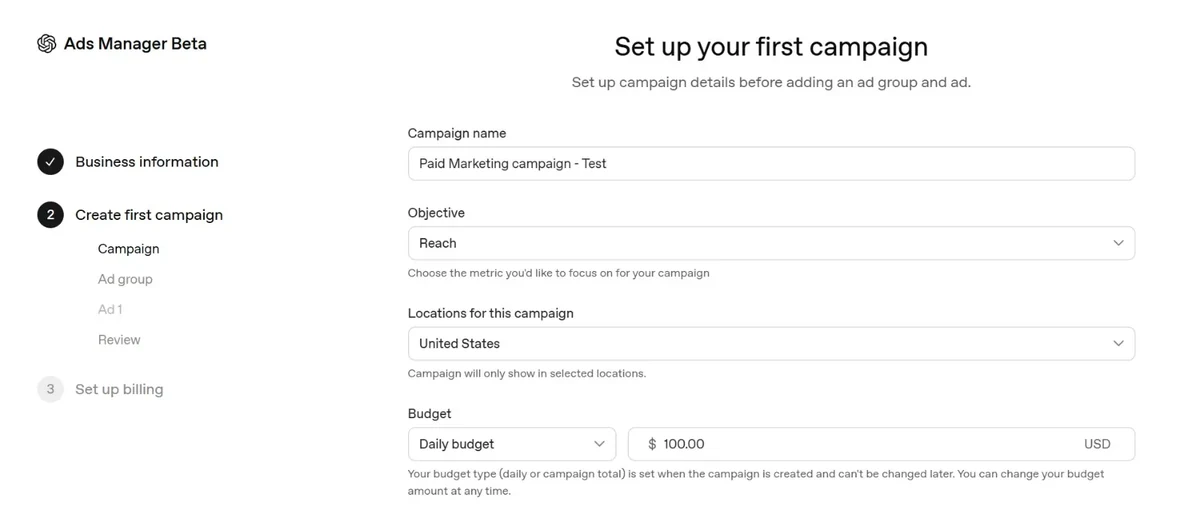

Adzlance recommends tracking ChatGPT Ads metrics in three layers: delivery, efficiency, and business outcomes. Start with impressions, clicks, spend, CTR, average CPC, and average CPM. Then measure conversions, cost per conversion, qualified leads, attributed sales, and ROAS where the required tracking is available. If you need the campaign and reporting structure managed together, review our ChatGPT Ads management services.
The mistake is treating every number as equally important. A campaign can produce a strong CTR and inexpensive clicks while generating poor leads or no sales. The best metric is the one that answers the business question you are trying to solve.
In this guide
- ChatGPT Ads Metrics at a Glance
- What are the most important ChatGPT Ads campaign metrics?
- How should lead generation businesses measure ChatGPT Ads performance?
- Should businesses track every lead or only qualified leads?
- How do you measure average order value from ChatGPT Ads?
- How do click through and view through conversions differ?
- Why can ChatGPT Ads, GA4, and CRM numbers differ?
- When should you change bids, budgets, or creative?
- A Simple ChatGPT Ads Reporting Routine
- About the Author
ChatGPT Ads Metrics at a Glance
| Metric | What it tells you | Best use |
|---|---|---|
| Impressions | How often ads were shown | Check delivery and reach |
| Clicks | How often people visited the destination | Measure traffic response |
| CTR | Clicks divided by impressions | Compare message and audience response |
| Spend | Finalized advertising cost | Control pacing and investment |
| Average CPC | Average finalized cost per click | Evaluate traffic efficiency |
| Average CPM | Average cost per 1,000 impressions | Evaluate impression efficiency |
| Conversions | Attributed campaign goal events | Measure selected outcomes |
| Cost per conversion | Spend divided by conversions | Evaluate outcome efficiency |
| Order sales and ROAS | Attributed order value and return | Evaluate ecommerce revenue |
OpenAI currently makes delivery metrics available at account, campaign, ad group, and ad levels. If this is your first campaign, use the ChatGPT Ads campaign setup guide to understand how those levels fit together.
What are the most important ChatGPT Ads campaign metrics?
I would review the metrics in this order:
- Business outcome: qualified leads, booked appointments, purchases, subscriptions, or another valuable action.
- Conversion efficiency: total conversions, conversion rate, and cost per conversion.
- Traffic efficiency: clicks, CTR, average CPC, and landing page engagement in analytics.
- Delivery and pacing: impressions, spend, average CPM, and budget utilization.
- Breakdowns: campaign, ad group, ad, device, country, and platform where available.
This order prevents the campaign from being judged by vanity metrics. Impressions prove that ads were delivered. Clicks prove that people responded. Neither proves that the traffic produced a useful customer action.
OpenAI does not publish a universal good CTR, CPC, conversion rate, or ROAS for every industry. Compare each campaign with its objective, customer value, market, previous periods, and other paid channels. Early data should be treated as evidence to investigate, not a final verdict.
How should lead generation businesses measure ChatGPT Ads performance?
For a service business, the reporting path should connect the campaign to the full sales journey:
| Stage | Metric | Question answered |
|---|---|---|
| Ad interaction | Clicks, CTR, average CPC | Did the ad earn relevant attention? |
| Website action | Forms, calls, bookings | Did visitors take the intended action? |
| Lead review | Qualified lead rate | Were the enquiries relevant and serviceable? |
| Sales process | Appointment and close rates | Did the leads progress? |
| Revenue | Customer value and acquisition cost | Was the campaign commercially worthwhile? |
Suppose a campaign generates 30 form submissions at $60 each. If only 10 are qualified, the true cost per qualified lead is $180, not $60. If three become customers, the media cost per acquired customer is $600. Those figures are more useful than the original form submission cost because they reflect the business result.
Lead quality can also reveal a targeting problem. Review the campaign alongside how ChatGPT Ads targeting works before assuming that a low CPC means the traffic is valuable.
Should businesses track every lead or only qualified leads?
A form submission is usually an early signal. It may be a genuine prospect, a job seeker, spam, an existing customer, or someone outside the service area. If all submissions are treated as equal, the campaign may appear successful while the sales team sees little value.
Use clear definitions. A valid lead provides usable contact information and a relevant enquiry. A qualified lead matches the service, geography, budget, or other sales criteria. A customer completes the purchase or agreed commercial action. The exact definition should be documented before the campaign is evaluated.
Send the primary website event to OpenAI using the Pixel, Conversions API, or a supported integration. Then reconcile campaign data with the CRM. Where the setup and consent rules permit deeper outcome reporting, use separate events for later stages rather than changing the meaning of the original lead event.
How do you measure average order value from ChatGPT Ads?
OpenAI reports Order Created Sales and Order Created ROAS from attributed order_created events. Other standard or custom conversion events do not populate those purchase columns. The purchase event therefore needs an accurate order value, currency, event ID, and confirmed order status.
Average order value is useful, but it is not profit. A campaign can produce a high AOV and still be unprofitable if product margin, discounts, shipping, refunds, or management costs are ignored. Compare AOV with cost per order, gross margin, repeat purchase behavior, and customer lifetime value where reliable data exists.
Use one currency and one consistent revenue definition. Decide whether the reported value includes tax, shipping, discounts, and fees. Browser and server copies of the same purchase should carry the same event ID and order value so deduplication does not create conflicting revenue totals.
How do click through and view through conversions differ?
A click through conversion follows an eligible ad click. A view through conversion follows an eligible impression when no qualifying click receives credit for the same action. OpenAI currently allows click reporting windows of 7, 14, or 30 days and a view through setting of 0 or 1 day. When both qualify, the click receives credit.
Report the attribution windows with every performance summary. Changing the reporting window can change the conversion total without changing campaign delivery, bidding, or billing. Use the same windows when comparing periods, exports, or analytics systems.
Why can ChatGPT Ads, GA4, and CRM numbers differ?
The systems answer different questions. ChatGPT Ads reports actions attributed to eligible ad interactions. GA4 reports activity using its own traffic source and attribution rules. A CRM records leads and sales according to business processes. Differences do not automatically mean that tracking is broken.
Compare the same date range, time zone, event definition, currency, attribution window, and reporting time basis. Check whether the report uses ad interaction time or conversion time. Also account for processing delays, consent, duplicate handling, view through attribution, and leads that are later disqualified.
When should you change bids, budgets, or creative?
Make changes after the campaign has enough activity to show a meaningful pattern and after recent cost and conversion data has finished processing. OpenAI notes that delivery metrics can update within minutes, finalized spend and cost metrics arrive later, and attributed conversions may require 24 to 48 hours.
Use the problem to choose the action. Low delivery may require a bid, eligibility, or audience review. Strong impressions with weak CTR may point to creative relevance. Good clicks with poor conversion rate may indicate landing page or offer friction. Acceptable lead cost with poor lead quality requires deeper targeting, message, or qualification changes.
Before increasing spend, compare the economics with the planning guidance in how much ChatGPT Ads cost. Protect profitable channels and scale a ChatGPT Ads test only when qualified outcomes support it.
A Simple ChatGPT Ads Reporting Routine
- Check delivery and technical issues frequently during launch.
- Review impressions, clicks, CTR, spend, CPC, and CPM for pacing.
- Allow conversion processing time before judging recent performance.
- Reconcile leads and orders with analytics, CRM, and ecommerce records.
- Compare qualified outcomes by campaign, ad group, ad, device, country, and platform where useful.
- Record every meaningful change so performance can be interpreted later.
For the wider strategy behind objectives, targeting, creative, measurement, and optimization, read the complete guide to ChatGPT Ads.
Frequently Asked Questions
Which ChatGPT Ads metric should I check first?
Start with the campaign objective and its business outcome. For a lead campaign, check qualified leads and cost per qualified lead. For ecommerce, check attributed orders, sales, cost per order, and ROAS. Use impressions, clicks, CTR, CPC, CPM, and spend to diagnose how delivery contributed to that result.
Does ChatGPT Ads report conversions?
Yes. Ads Manager can report attributed conversions when conversion measurement is configured and the selected event matches the campaign goal. OpenAI currently supports the Measurement Pixel, Conversions API, and supported integrations. Recent attributed conversions may take 24 to 48 hours to appear.
What does CTR mean in ChatGPT Ads?
CTR is the percentage of impressions that produced a click. It helps compare how strongly different ads or ad groups attract traffic, but it does not measure lead quality or sales. Review CTR with CPC, conversion rate, qualified outcomes, and landing page performance.
How do I calculate cost per conversion?
Divide campaign spend by attributed conversions for the same reporting period and attribution settings. If a campaign spends $1,000 and records 20 conversions, the cost per conversion is $50. For lead generation, also calculate cost per qualified lead because not every conversion has equal commercial value.
Does ChatGPT Ads report ROAS?
OpenAI reports Order Created ROAS when attributed order_created events include valid purchase values. ROAS compares attributed order sales with ad spend. It does not represent profit, so ecommerce advertisers should also consider gross margin, refunds, discounts, shipping costs, and repeat customer value.
How long does ChatGPT Ads reporting take to update?
Impressions, clicks, and CTR can update within minutes. Spend, average CPC, and average CPM depend on finalized activity and may update later. Attributed conversions can take about 24 to 48 hours. Avoid evaluating the current day as if every metric were final.
Why is my campaign getting clicks but no conversions?
First confirm that the selected conversion event is attached to the campaign and firing correctly. Then review traffic relevance, ad promise, landing page speed, mobile experience, offer strength, and form usability. A technically correct click does not guarantee that the visitor is qualified or ready to act.
How often should ChatGPT Ads performance be reviewed?
Check launch delivery and tracking frequently, then use a consistent weekly review for most active campaigns. Evaluate pacing, cost, conversions, lead quality, and revenue together. Major changes should be based on enough volume and finalized data, not a few clicks or one incomplete reporting day.
About the Author
Gurdeep Singh is the founder of Adzlance and has more than five years of paid media experience across Google Ads, Meta Ads, ChatGPT Ads, conversion tracking, and performance reporting.
Practical ChatGPT Ads Guides
Continue with campaign setup, targeting, and budget planning.